
I reckon they grow on trees these days… or in modern flowerbeds laid out especially for them. I mean narcissists, of course, not to be confused with narcissi. The funny thing is that I probably don’t even need to explain what it means, narcissist, because nearly everyone knows one: an ex-partner (that’s most of them ;-), a father, mother, a good friend who may no longer call themselves a friend. And opposite them, so I’ve been told, stands the empath. These are the daisies, because empath sounds far less interesting and easy on the eye than narcissist, and that doesn’t seem fair to me. Since we’re in the flowerbed metaphors anyway. Ahem, and I mustn’t be dismissive about this, because empaths suffer quite a lot of harm from narcissists. Or so I’ve been told, and the balance of power is out of kilter, if I understand correctly, because the empath has precisely the character traits that a narcissist can conveniently exploit, or at least play on. That makes empaths manipulable by definition and narcissists the manipulators. I lay this before you a touch despairingly, because I wonder how good it is for us and our fellow human beings that we’re all going around playing therapist. And I fall for it myself, mind you. With all the self-help books, coaches and easy-access therapies, you’re more or less qualified for it by now. Still, it’s quite something to call someone a narcissist and in doing so say out loud (because that’s how it comes across to everyone who hears it) that you yourself are barely to blame for the relationship going awry and that the other person has a condition that can barely be fixed.
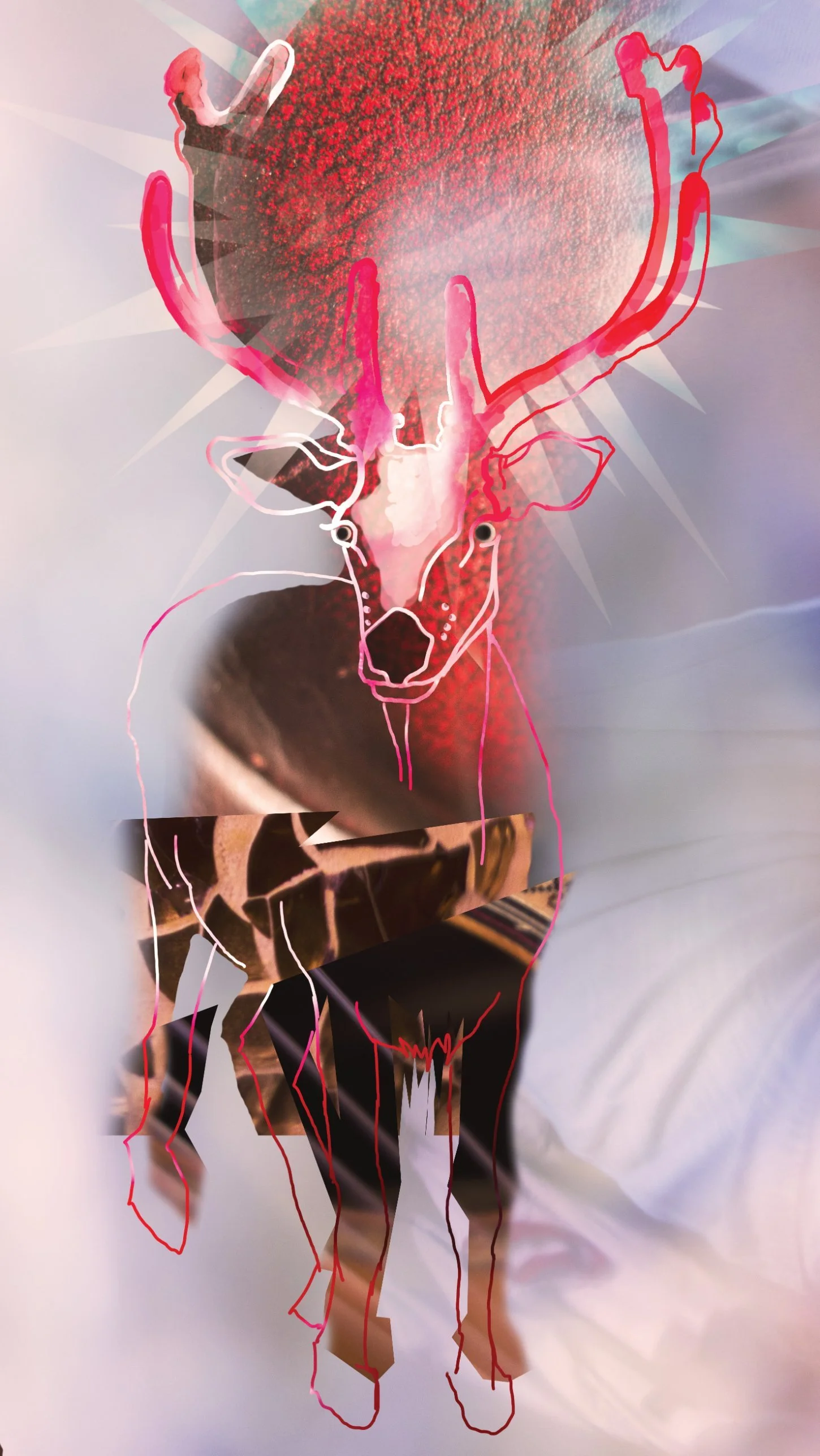
‘Oh, my dear…’ – digital graph art, 25 × 44 cm, edition of 10, 2014
Is narcissism an affliction? Can you grow out of it? Can you therapy your way through it? Aren’t we all hugely narcissistic? Isn’t narcissism encouraged a little by individualism? Can narcissism be temporary, or only visible in certain situations or with certain people? Are any causes of narcissism known? I suspect each of us sits somewhere on the narcissism scale, and now I’d quite like to know what that scale looks like and where I score. I gather artists are the biggest narcissists, so I’m already puffing out my little bosoms. (Pardon, my chest.) And then the daisy scale straight after, because that’s just as interesting. And are empaths the good guys by definition? I hereby set the cat among the pigeons, and just for the record: ‘Don’t shoot the messenger.’ I’m merely researching. Do with it whatever feels right for you.
I’ve just taken a homespun test myself (feel free to put yourself under the microscope too, but above all don’t take it too seriously; these tests are loosely based on scientific research and not intended as self-diagnosis) and discovered that I find it rather offensive of myself that I’m not a bit more narcissistic, ha! Didn’t see that one coming. Why, for example, do I find it hard to walk into a room and then get the attention? A compliment does land, but at the same time it makes me hugely uncomfortable, and yes, secretly I’d very much like to be special, but I see so many remarkable, loving and gifted people around me that I can’t in good conscience place myself above them, not even in the darkest corner of my own little room with the curtains drawn. I score poorly on feelings of superiority, let’s put it that way. That sounds like a blessing, but also like a lack of self-assurance, and that’s quite a handicap. If I’m to believe the last section of the test, this actually means I’m a touch narcissistic. I do believe in constructive feedback, but when I receive fierce criticism, I can keep repeating it to myself for a long time. And I’m working towards not always needing validation from others, but I’m not finding that easy. All in all, rather narcissistic, it turns out. And then the daisy test: apparently I’m a whole field of daisies, but there’s plenty to be said about that too. Thanks to my surroundings and my role as a parent, I’ve had to practise setting boundaries a great deal, and I’m getting (very slowly) a bit better at it, but being a hardcore empath certainly has its shadow sides. And knowing what’s on someone’s mind, being able to pick up on what someone’s sensitivities are, gives you quite a responsibility to handle that respectfully and discreetly. And let’s be honest: in the end you reason everything from your own frame of reference, so being completely empathetic is, realistically, all but impossible for us ‘flawed humans’. According to an English study, there are more empathetic villains, who show many dark traits and are empathetic, than villains with little or no empathy. The dark empaths go about it more subtly, because they sense where the pain or sensitivity lies.
Now that I’ve talked rather narcissistically mostly about myself, it’s finally time for a few titbits. Causality is never clear-cut, and it isn’t here either, but there are two theories that are deliciously at odds with each other and are linked to more traits on the narcissistic spectrum. The first is that your parents barely noticed you and you built up an unrealistic self-image for your sense of self-worth; the second is that your parents praised you to the skies and in doing so created the idea that you are indeed fantastic. Research proves them both a little bit right: being put on a pedestal is linked to the grandiose narcissist, neglect to the quiet, vulnerable kind. Narcissism apparently isn’t an affliction but a trait; only the very tip of the scale is a disorder. An official diagnosis is made on the basis of nine characteristics, at least five of which must persist for a long time and cause real harm for the label to fit. Naturally, only a professional, such as a psychiatrist or clinical psychologist, may make this diagnosis. Of course there is a scale, so we can all be more or less narcissistic, but it has been estimated that the genuinely harmful disorder affects only 0 to 6.2 per cent of the general population. Getting older does indeed mellow us, so the passing years help here too. In general, people become less narcissistic as they age. The fact that we’re now discovering narcissists all around us by the bunch has nothing to do with numbers peaking at the moment. If anything, a slight decline has been observed, but as with everything: as soon as your attention is drawn to the yellow car, you suddenly see yellow cars everywhere. Therapying your way through it is quite a challenge in severe cases, apparently, but not impossible. Narcissism certainly depends on the situation and can rear its head more with one person than with another. There is a link between narcissism and individualism, but not so strong that we need to dwell on it at length here. As for the narcissistic artist: I can let the air out of my bosoms again, because it’s mostly narcissists who consider themselves highly creative, yet in an objective, blind assessment they don’t necessarily turn out to be more creative. Actors and other people with a stage do score higher.
Psychologists warn against casually throwing the label ‘narcissist’ into a conversation about the first person who, in your eyes, has clearly been preoccupied with nothing but themselves. That’s not to say it wasn’t so, but with that label you shut the conversation down at once: the other person is ill, I am a victim. For those who have truly been damaged, the word can actually be something to hold on to, and I wish that for everyone. At the same time, the label also means you stop really looking at your own part in it, and in doing so you’re behaving (frankly) rather narcissistically, if you ask me. Mind you, I’m in no way saying anything about your situation, because I wasn’t there. I’ve merely concluded that you can’t just go weeding and replanting in someone else’s little garden. And should you share a garden and the narcissi take over, so that the daisies no longer stand a chance, then perhaps an allotment is an idea? But joking aside: if your self-reflection, your own soul-searching, doesn’t set anything in motion, then it may be time to fence off your little garden or to up sticks. Your daisies, and to be fair your narcissi too, deserve a spot in the sun.