
Some of you may already know it: ‘The Miracle Morning’. Years ago I read something about it after an old friend told me he took an hour for himself every morning to start the day well. He would write in a journal, meditate for a while, walk, do some exercises, just the way he had worked it out for himself. I did the same for quite a while back then. I was already devoted to my sunrise walks with my dog Noah; to those I added a short meditation, or a moment of reflection, and I put a few words down on paper. I remember feeling I was one-nil up on the day, on time itself, because that precious moment for myself was already in the bag. Nobody could touch it.
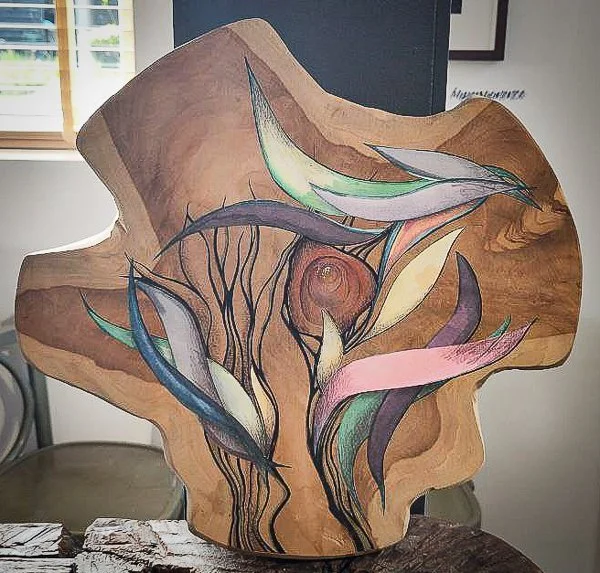
‘Autumn Leaves’ – mixed media on wood, approx. 30 × 28 cm, 2024
I read too much, and you’re welcome to have an opinion about that, but last week an article caught my eye about the benefits of exercise as the very first thing of the day, alongside a regular sleep rhythm, especially for people with an overactive mind. That’s all three of us, I thought straight away, so I put it to the family group chat. Would the gentlemen like to get up earlier with me in the mornings to do some sport, before breakfast and school or work? Imagine my surprise: ‘Both were wildly enthusiastic!’ The idea was that we would take turns deciding what to do, and my son got to choose first. So the next morning at half past six the three of us were out on the field playing football, and the dog was just as happy, because suddenly she had endlessly more time to have a good sniff around and gaze lazily in our direction, wondering what on earth we were doing. I’m projecting my human thoughts onto her for a moment, but I thought I could see her wondering: ‘What new regime is this? These people have really lost the plot!’
On day two my husband wanted to do yoga. That was a tough session, as it asked rather a lot of each of us, unpractised, stiff people that we are, but that didn’t matter, because it was his turn and we dutifully followed in his footsteps. The day after that, at my request, tennis, and the following day my son wanted the same, ‘but a bit longer this time, please, Mum’, because half an hour is over in no time, of course. So on that particular day we were on the court at a quarter to six, while it was still dark. On the last day of that first week we set off on our bikes at the crack of dawn to take on the adventure of the stone mountains and the tennis balls. And so we made it through the first week, all three of us with a sense of victory. Not only had we got up on time, we had also moved, each of us had had a say, and what I cherished most in the end was the time we shared at this special moment of the day, when the world is still half asleep, the animals are just waking up and the sun has yet to show its face. The world is serene, our thoughts still fairly clear, our mood bright, the page of the day unwritten… The first letters of the book would form the words of that shared moment, and once again no one could take that away from us.
It’s as if the rest of the day leans on such a good start, and it touches and infects every moment that follows. I’m not going to say it’s easy to get up that early, especially after a weekend. Still, so far I can only say that it does us good and that it’s worth it. We make our shared time, the movement, that still untouched moment in the morning a priority, and in doing so we look after each other and each other’s wellbeing. I am happily surprised and touched by this discovery.
And what do you know? Marcus Aurelius was no natural morning person and struggled to get out of bed, so he wrote a short passage encouraging himself to step into the morning on time. In his Meditations (Book 5.1) he asks himself whether he was perhaps made to stay under the blankets. Plants, birds, ants, spiders and bees all do their work, so why not him? Like me, he feels the pull of the warm blankets, the half-sleep still tugging at you, and yet he considers it important to catch that part of the day. In Book 2.1 he begins his day by preparing himself for the people he will meet that day, and in Book 11.27 he takes inspiration from the Pythagoreans, who looked to the heavens first thing in the morning. From more recent sources I know that the first morning light sets your body clock, so that melatonin production starts at the right time in the evening, helping you fall asleep more easily and sleep better.
Henry David Thoreau (Walden, 1854) has a few beautiful lines that touch on my rapture at that pristine start to the day. ‘Morning is when I am awake and there is a dawn in me.’ Beautiful: a dawn, but inside you. That is genuinely how it feels to me. ‘Every morning was a cheerful invitation to make my life of equal simplicity, and I may say innocence, with Nature herself.’ Being outdoors in particular lets your own nature synchronise with that of the world around you. Once that connection is there, you can draw on it all day.
Psychological studies have shown that young children at school benefit from exercise they had earlier that morning. Their mood and attention improved, and they also clashed less with those around them than usual. And then there is a study that had rowers train alone and together, which found that in a team they could tolerate more pain, taken as a sign of greater endorphin release (the happy hormone). We don’t need a study of rowers to realise that shared time is valuable and that we’re more willing when we’re together. Still, it’s nice to have it confirmed.
I know myself and my family well enough by now, and no two weeks are the same. Even so, I would love to make this a fixed family ritual. Those five days alone have given us enough to say that wish out loud. Of course, you may not be much of a morning person, and enough sleep is important. So I’m now turning in a little earlier, and even my son wants to go to bed earlier because he enjoys it so much. To me that says enough about its value, because normally you can’t get him to bed for love nor money. I’m curious how long he’ll want to keep up the miracle of the morning; one day at a time, I tell myself.