
FARMERS IN THE FOREST
From the series Bright Spots
Piglets. I can't help it, I think they're wonderful, with their gorgeous, chubby, dreadfully filthy little snouts, their lovely grunting and their rooting about in the earth. They seem so playful and uninhibited. That's very much my thing: that mud-caked delight in play. When my child comes home filthy from top to toe after a day playing outside, my heart lifts a little, because he can only have had a great time. And when I see those pigs stacked up in factory farming, destined to serve as our food, the opposite happens and my heart sinks into my boots. What has become of us humans, that we think we have to treat our animals like this?
But I won't dwell on that at length, because this column belongs to the category 'bright spots'. Its aim is to show all the lovely things we humans do, the wonderful initiatives we take, and how we're capable of bringing more colour to the life around us without bending everything to our will.
That love for animals finds expression in Boeren in het Bos — Farmers in the Forest — the business run by Richard and Mariska. I'd never heard of them, until I spotted pork belly slices bearing their name in the freezer at my regular food supplier, the Graasboerderij in Sondel. I don't eat much pork any more, for exactly the reason I just gave, but secretly I love it, and my child loves it even more. So to treat him I took a pack home, and it turned out to be the jackpot.
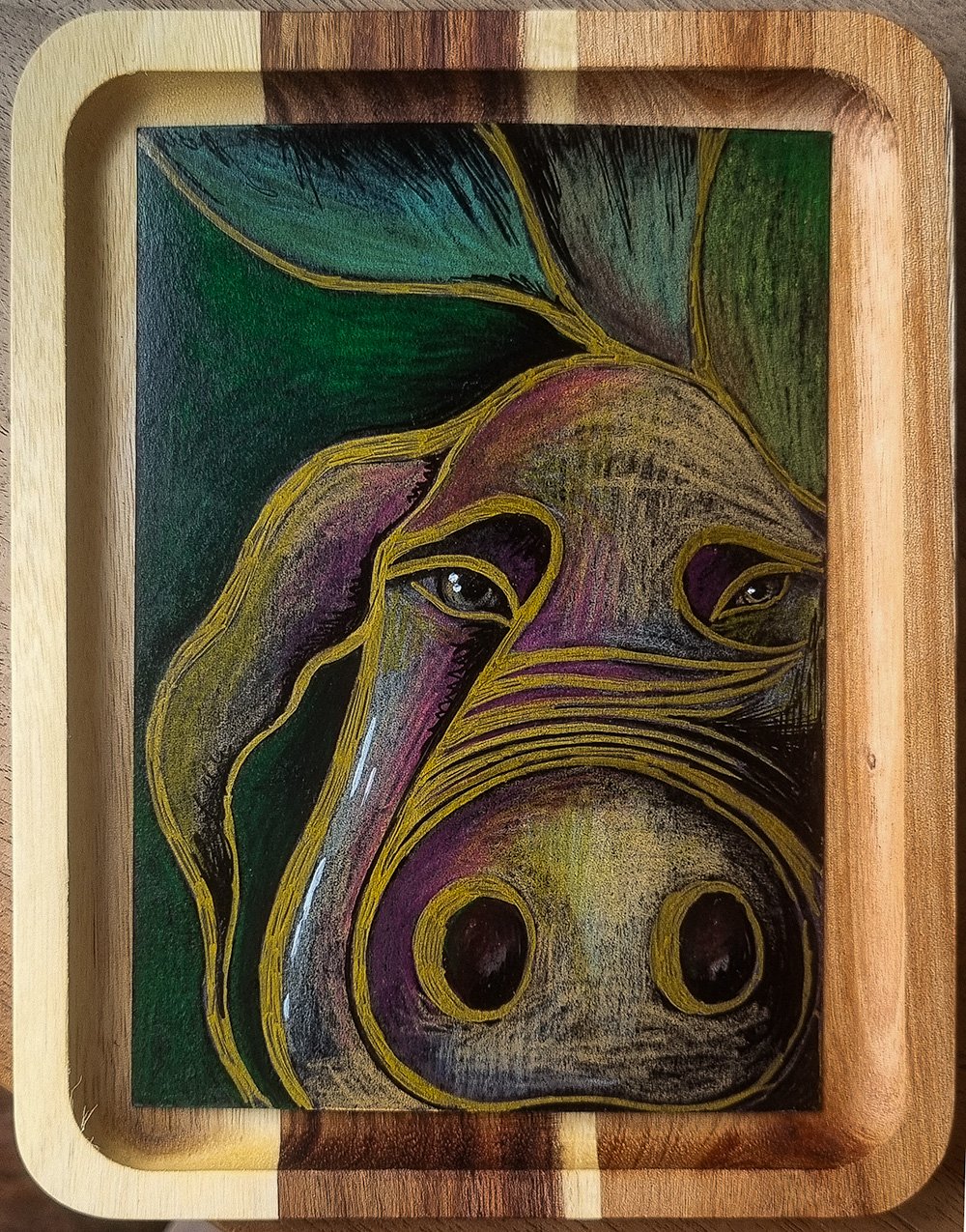
'Piggy' — drawing | 14 × 11 cm | series Short 'n Sweet | 2026 (wooden frame, fixed)
At my table there's a fair bit of nitpicking whenever I serve something healthy, but this time the deliciousness could be heard between all the contented sounds. There was eating. And the thought that the animals that had given their lives for our food had lived a meaningful, playful, good life added something to the taste — literally and figuratively. Because I'm certain I could taste it: the variety in their diet, their free rooting, the fact that they were allowed to be more than just food on our plate.
I'm grateful to this pig-loving couple for making that little piece of meat, and the feeling that came with it, possible. They live in Nijeberkoop, a stone's throw from Appelscha in Friesland, and their chestnut-brown pigs roam the forest in family groups, where father pig builds the nest and the piglets stay with their mother. Isn't that exactly how it's meant to be?
Every now and then I tell my child, half joking, that I'd like a piglet as a pet, and something in me would genuinely love that. But once he's got thoroughly excited, I have to disappoint him with the facts. Our house is not a piglet's natural habitat. We'd cuddle it to death (one way to go ;-), but sadly that isn't enough for a pig. We've no grass, no mud, no safe spot to build a nest, and — perhaps most important of all — its family would be missing. We'd have to be its family, but the last time I grunted, it was because I'd laughed a bit too heartily. You get the picture.
Besides the couple in the forest with their pig families, there are also two men in the polder with an interesting project, which makes it good news twice over. They deploy their pigs as nature managers: the pigs root invasive plants out of the woodland, and the meat comes along as a bonus. The organisation is called Bosvarken — Forest Pig — and works with, among others, the national forestry service and the province of Flevoland to clear invasive plants such as Japanese knotweed and giant hogweed from certain areas in the long term. Pigs are said to be better at this than machines, and on top of that their rooting enriches the soil rather than churning it up.
This Sunday, 4 October, you can go and see for yourself: Arthur and Daniel are holding an open day at the Centrum Stadslandbouw in Almere-Oosterwold. Go out with your children beforehand to collect acorns and nuts, because these omnivores adore them — and on the open day the children are allowed to feed them to the pigs. (Only bring the brown acorns, and let them dry first.) Isn't it special that these pigs have such a meaningful job? They're said to be very intelligent animals, and it may well be that they rather enjoy being useful. And 4 October is World Animal Day, so be extra kind to them, and to all the other creatures around you…