
Lees deze column in het Nederlands
Xandra Dupper — September 13th 2026
The history books tell us that around 1800, babies who wouldn't stop crying were given a dummy smeared with sugar, or a little cloth bag of sugar to suck on — a 'sugar tit', as it was rather bluntly called back then — and it settled them nicely. The Americans still carry that logic in their word for the object: a pacifier. Something that makes you peaceful. Quiet. In Dutch we call it a zoethoudertje, literally a little something to keep you sweet, and we use it for anything you're handed to stop you complaining — which may also explain why a well-behaved Dutch child is called a zoet child, a sweet one. As far as I'm concerned, this tiny scrap of history already makes clear how desirable it was, even then, to silence a human being — a very small human being, no less — temporarily. And sugar was an effective means to that end.
Why is sugar so tempting? The need for it is existential in nature, and our brains are programmed for it. Long ago, finding something sweet, in the form of fruit, was rare, and it meant two things: quick energy and safety (hunger temporarily lifted). And here too the word dopamine comes into play, because that's the 'wanting' chemical (people also call it the happiness chemical, but nuance matters here) that's produced the moment sugar enters the human system. It drives you toward the reward and it stirs your longing — longing for more. So the joke is that we're biologically kept sweet by Mother Nature (you aren't satisfied, you're kept talking). Because for survival's sake it matters that you keep going out to look for it. (Bitter plants, by contrast, were often poisonous — no neurological reward.) A 'flawless' system that worked well back when we still took our food from nature and understood our body's signals rather better.
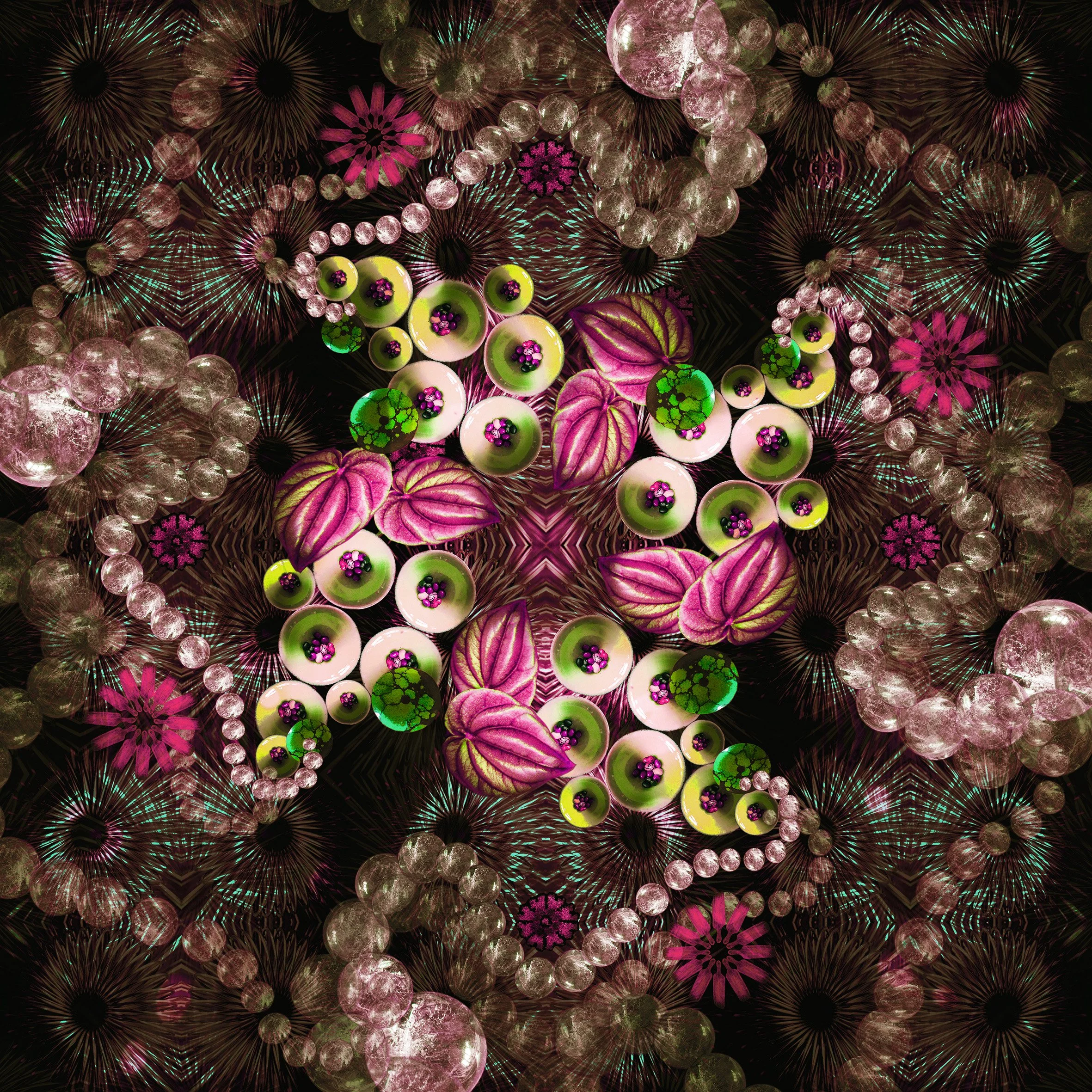
'Beautiful Jungle' — digital art collage from the You + Me series | 90 × 90 cm | 2016
Quite a while ago now, I saw a documentary: 'That Sugar Film'. In it, Damon Gameau, an Australian who ate no refined sugar himself, spent sixty days eating forty teaspoons of sugar a day — exactly the average of what his fellow countrymen were taking in daily. But exclusively from products with a reputation for being healthy: low-fat yoghurt, breakfast cereals, muesli bars, fruit juices. No sweets, no fizzy drinks, no ice cream. In the meantime he went out investigating, and had himself tested regularly to see how his health was holding up. Why take in sugar in such a convoluted way? You could just buy a bar of chocolate and be done with it. But that was precisely his point: how much sugar is worked into manufactured food — and for what reasons. Eighty per cent of the food in the supermarket contains sugar, most of it entirely unnecessary. In a great many products that sweetness doesn't even serve a purpose, except — pay attention now — to make you buy more of that product. Especially once they've managed to hit the 'bliss point', which people devote entire studies to, all to ensure that you, the consumer, can't get enough of it. Literally and figuratively, but above all figuratively.
Fructose is the stuff our bodies have the most trouble with. Because what happens the moment your insulin rises, the battle with the sugar is in full swing and your liver can barely keep up? It gets converted into fat, which is then stored, particularly around the belly. Visceral fat, they call it: not the fat that gathers under your skin, but the fat that encases your organs. The not-so-good kind, the sort that can genuinely cause problems. What happened to Damon, our guinea pig, was something even his attending physician couldn't have predicted: within eighteen days he'd developed a fatty liver, which means that fat is being stored in the liver cells themselves. This organ, which makes sure everything is transported to the right place and waste products are carried off, needs every one of its cells, especially given the way we live these days. Where people once took in a few grams of sugar a day, for the average Westerner it's now many times that — and mostly by way of products marketed as healthy. That's where the art of reading the small print really begins. My child is getting rather good at it, because when I say small print, I do mean small print. Without glasses and good light, entirely illegible to me.
Do you know how many words they've come up with for sugar, so that you don't notice that it's in there, or how much? Here it comes: more than sixty. And do you know why? When people discovered how much sugar was ending up in manufactured food and started studying ingredient labels, the 'cheats' (I really can't see it any other way) began splitting sugar up into various sugars. The ingredient with the greatest weight has to be listed first, you see — but if you divide it up into sugar, glucose, fructose, maltose, sucrose, assorted syrups and so on, it slides down the list of its own accord. If it ends in -ose, a little light should come on. Count several -oses and you may safely add them together, and you can reasonably assume that sugar should really have appeared first on that label, or at the very least among the first. Sigh. You practically need a degree for it. And that's only the sugars — I'll spare you the rest for now.
Right, back to our good father, who was willing to carry out this risky experiment for his children, so that they'd grow up informed. (Which is also why the film is genuinely semi-fun to watch with your nine-year-old, because he added animations and comic characters to it.) Within twelve days he'd put on a good three kilos, and he hadn't touched a fizzy drink or a piece of chocolate. By the end he was in a bad way: a fatty liver, eight and a half kilos heavier in total, seven per cent more body fat, early signs of type 2 diabetes and an increased risk of heart disease. But what's also remarkable is that his wife noticed his character changing. That he became more volatile, more melancholy, less steady and balanced. He noticed himself that he was starting to need sugar as a pick-me-up, the way other people can't seem to get anything done without coffee. And he'd turn grumpy if he couldn't get his sugar intake in on time. He felt lethargic, generally more depressed, more stressed, less sociable — and he lost his sense of taste. It took a full eight days afterwards before he could perceive the nuances of real food again.
So that's how nicely you're kept sweet, by the industry and by the sugar itself. It holds you hostage, as it were, and some researchers compare its effect on the reward system to that of cocaine, alcohol and smoking. I'm a sucker for chocolate, and if I'm not careful I can't stop. Then I really do have to rein myself in so it doesn't escalate. I was standing at the checkout in the supermarket, and there stood a lad of not quite ten paying for three bags of sweets, plus a fizzy drink (liquid poison — I could devote a whole chapter to that; it goes straight into your bloodstream, and oh boy, the high you can get off it). I could have burst into tears on the spot, because children are apparently free to buy whatever they fancy, funded by the deposit money from all the returned bottles and cans, without their parents needing to know a thing about it. And hooked they are, at a very young age. As a mother I'd love to say something to the lad, but let's be honest: I'm no match for the colours and the promise of the short-lived kicks they're about to get, however good my intentions. What's more, I can barely resist the temptation myself. It's a serious business, this sugar, and it would be a fine thing if we all took it a little more seriously, especially for our children's sake.