
This one is especially for you, Chris… thank you.
How do you write about happiness without turning maudlin the moment you start. A good friend, who also reads my stories, nudged me to give it some thought. As chance would have it, much earlier in time I’d once held a book at my sister’s place, by a former Google employee, if I remember rightly, who thought he’d found the formula. Naturally the book became a bestseller — because drinking from the magical fountain of prosperity, good fortune, and wellbeing is something we all want. Whether it actually offered any practical handholds, I can’t recall; what I do recall is that his background is worth mentioning. He had, you see, lost his son. A boy who was in the middle of his life, and from whom he, as a father, had to take his leave in far too short a time, and at far too young an age.
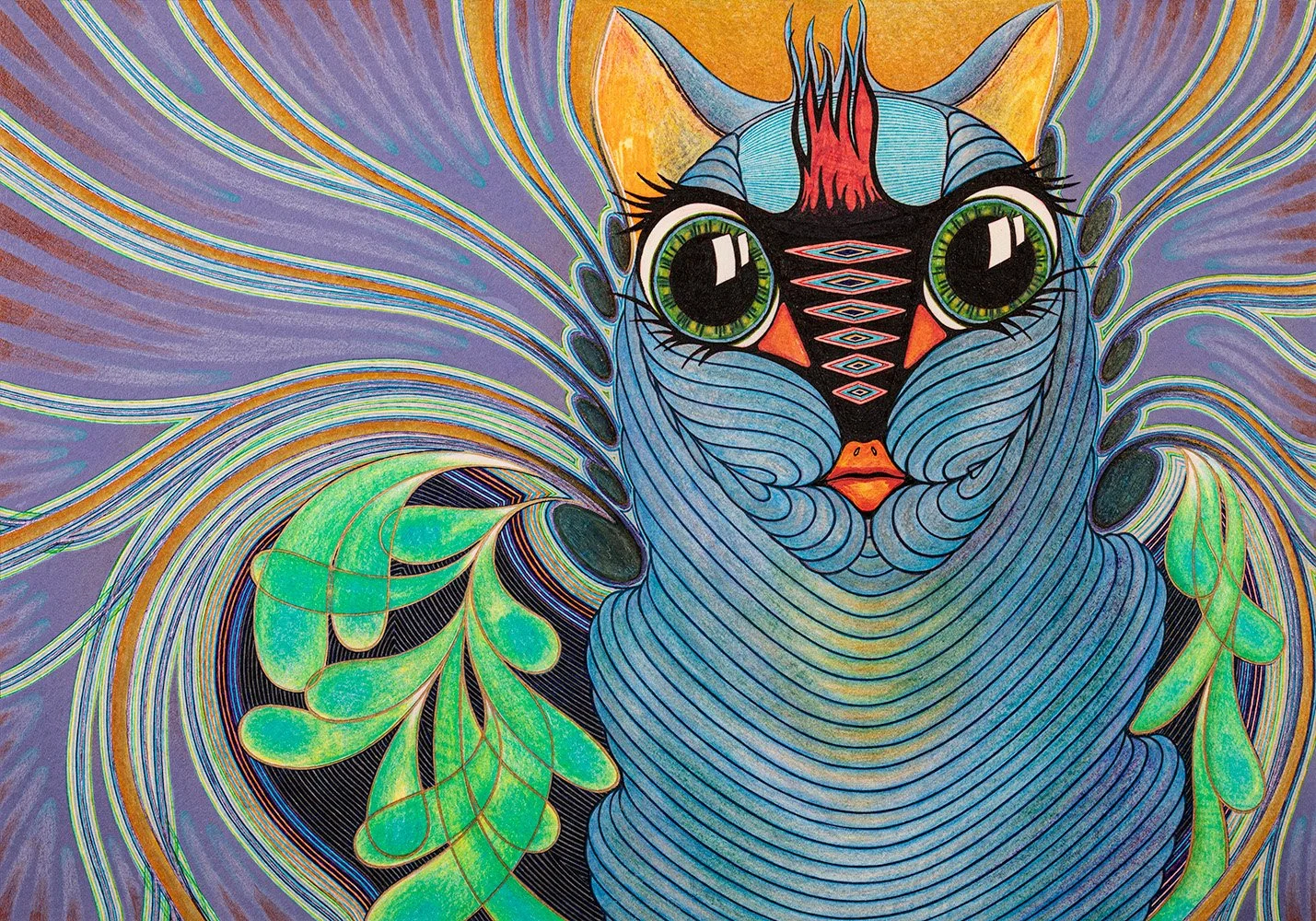
‘With My Hair on Fire’ – mixed media 29 x 42 cm | 2020 | SOLD
Having to bury your child is, according to virtually everyone including me, the worst fate that can befall you as a parent, and of the pain I can only form an idea. I choose not to do that, because the mere thought brings me to my knees. Now, I’ve certainly known my share of loss too, and I’d like to share that — beyond being something that cries out to heaven, heart-rending, and destined to hold a marked place forever in the history of your memory — loss is also a magical event; loss that comes in all sorts and ways, is what I mean by that. For some reason every loss brings me closer to myself — the loss another is grappling with, too, by the way — and in more than merely the guise of my sense of perspective. You can get so caught up in life’s trivialities, the everyday grind of existence, and feel the heaviness there, the frustration at its repetition, the trouble seeing the bright spots. But in such a moment of extreme grief — an unexpectedly painful announcement, a powerless having-to-accept a farewell — time stands still in me for a moment, and I seem to see my surroundings better, to recognise the moments better.
When my dear friend died too young, I’d just come out of a divorce, and my father lay on his sickbed, I was — as a kind of counter-move — suddenly living life to the full. You could also call it distraction, sure. But I remember well how that one sailing trip became unforgettable. Because of the circumstances, I only truly saw the flickering light on the waves; the rays that were poured through the cloud cover as though God had personally had a hand in it left me stunned; the light breeze in my hair had become as tangible as the sensuous touch of someone else’s hand on my skin; and my own humming was seamlessly taken up into the sounds of nature around me, as if it were a symphony. I don’t want to romanticise the sorrowful, and I realise that people will now rise up, perhaps even feel the urge to unsubscribe from these reflections — because how could you possibly belittle another’s pain like this? I hope you’ll stay with me a moment longer, because that is not what I’m trying to do. The pain is there — searing, sometimes almost unbearable, and often lingering with you, in waves of rising and ebbing intensity. I’m not going to reason it away. But in the quiet moments around it, I seem to need less, and I stand more open to the remarkable world around me.
Maybe a little scene will help. For two weeks now I’ve been sitting in an uncomfortable feeling. The hormonal swings seem to have a grip on me at the moment, and from time to time they make me downright melancholy. Then it genuinely hurts — the disorder of the world around me, the effort it takes to keep the connection with one another. And yet it leaves me keenly alert, and I seized the moment to paddle out on my SUP into the backwater canals and surround myself with nature from the other side (that’s what I call it, from the water). Dragonflies flew alongside me, side by side, as if we formed a team; tree stumps stuck up out of the water along the bank and embraced the many water lilies that, thanks to the dawn, slowly opened before me. Damselflies crisscrossed the flat water right past me, as if mocking my lumbering. Little reed warblers chattered back and forth and left me in silence. A kingfisher dived over the water, turned in the air so that I could see both the fox-red of its breast and the gleaming green of the plumage on its back. And later another of those lovely long-billed fisher-birds, making its dynamic flight low over the water while checking how the fish stocks were doing there. And completely unexpectedly (I’ve been looking for them all summer) I saw four teeny-tiny little black-exploded coots there, with red bills. If I could have melted on the spot, I would have. Blackberries for the taking, the sun on my snout, the flat water that lets itself be set in motion by the driving force of my paddle and I. Serene moments that come to me fully more often when I accept the heaviness of life, feel the emptiness, embrace the grief. It’s not consolation, but it is what it is. And from that I draw, for a brief moment, happiness. The smile on my face after the sight of the young chicks stayed with me for minutes afterward, and it was completely free, all of it. The sun, the water, the beautiful untouched nature, the creatures of nature within it, and I.
Back to that man with his formula, the one I began with. Mo Gawdat, he’s called — once a top executive at Google, an engineer who approached happiness the way you solve an equation, and who put his model on paper in the weeks after he lost his son Ali. It’s barely comprehensible, really: that at exactly that moment, immersed in raw grief, he picks up his pen. In his search for the solution — the release from his grief — he arrived at this: happiness is not how good life is, but how it compares to what you expected of it. Reality minus expectation. And neuroscience, which independently of him built an actual equation for it, says exactly the same: we’re not happy when things go well, but when they go better than we thought.
That was exactly what happened to me in that unguarded moment on the water. I set out with a head full of heaviness, without any expectation — no fountain to drink from. I came empty-handed. I sometimes say that, jokingly, to know-it-all optimists: ‘You’re better off expecting the worst — then it can only turn out better.’ Insofar as logic is measurable — however hard science may try — experience, at least, shows that happiness is greatest in the space you leave empty. It can’t be chased, only received.
Did you know Omaria is now available in English? A print edition is on its way — but until then, grab your e-reader and dive in…