
The days seemed strung together by unspoken accusations, back and forth. Both of us had withdrawn — out of fright, out of fear. Grief hung over me like a cloak, and I could barely hide that I was wandering around lost, my soul tucked under my arm. How misunderstood I felt, cast as some kind of monster, when all I wanted was to bring clarity, to draw a line, to make the day-to-day a little lighter. My intentions were nothing but good. So were his. He didn’t value mine.
Here the dilemma rears its head. My consciousness is locked inside me. I can’t reach across the border of my own skin and truly feel what is experienced there, on the other side (in the other person). The moment the setting changes, I lose access; it’s no longer tangible to me. That’s when those strange things called words come into play, because they’re the ones meant to carry the emotions housed in me and in him. They’re supposed to be able to get the message across — but more often than not, they don’t. For me, language is like paint on an abstract canvas, something you’re allowed to splatter around with wild abandon. For him, language is a precision instrument. He moves like a surgeon with only a few millimeters of room, threading his instruments through to land exactly where it hurts.
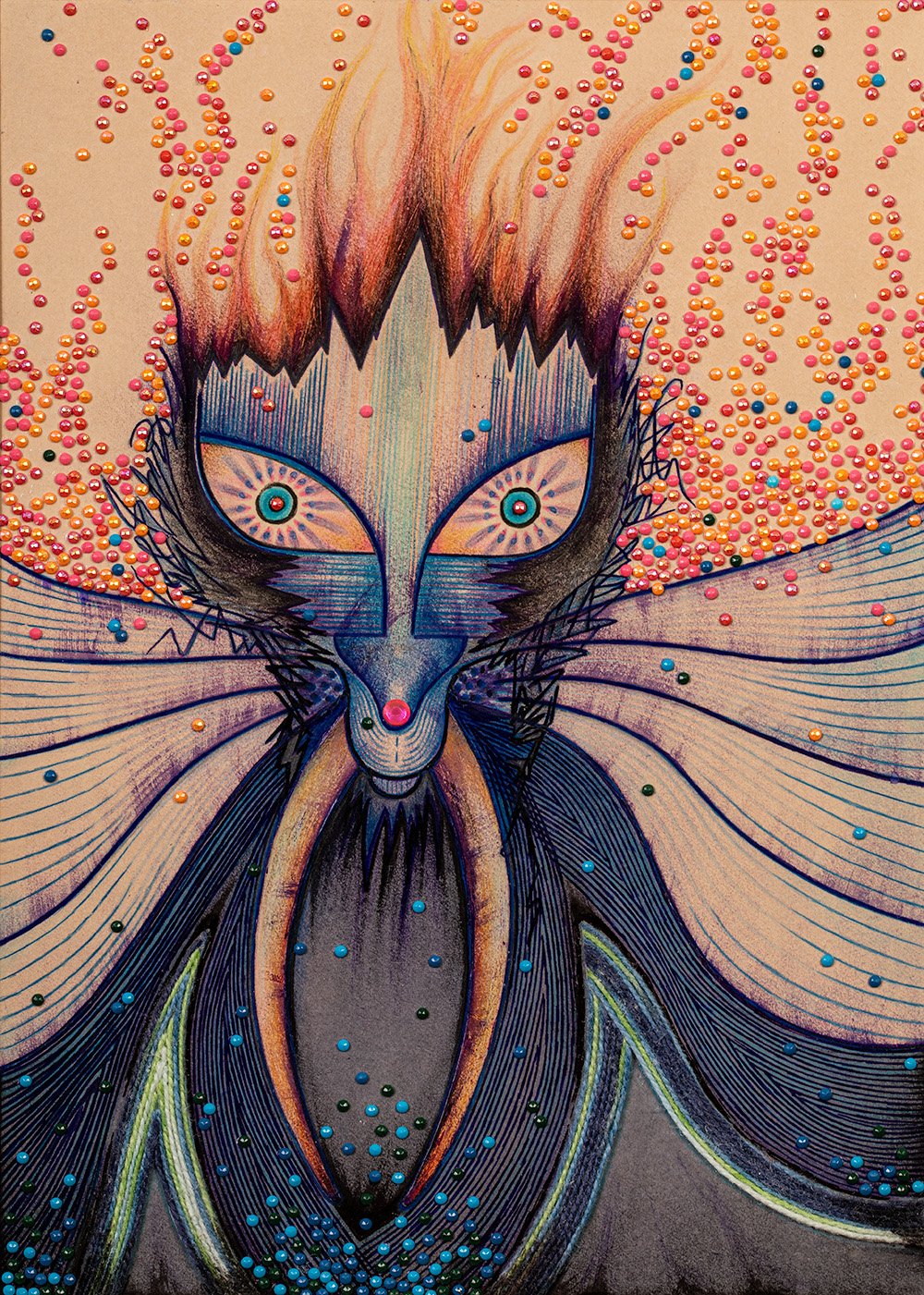
‘Devil In Me’ - mixed media | 29 x 21 cm | 2019 - SOLD
And so I fling paint that runs off the canvas on every side, while he cuts with a lens over his right eye, precisely there, removing something small but leaving something large in place. Inefficient in both directions. Because if the listener can’t decode the other’s words, what good are they? And the more words there are that can be misinterpreted, the greater the damage done.
What if you don’t speak, but come together in silence after a quarrel? With the intention of finding your way through it together. What if you first explore the parts of each other that you value anyway, that need few words? What if you laugh together first? What if you simply touch each other first? What if you just are together, without expectations, without that good talk, all those things that still need to be said, the agreement that’s supposed to follow… What if you just leave it as it is — not even in each other’s company, the hurt absorbed and feeling misunderstood? Do we always have to agree? There’s more than one road to Rome, after all — assuming you both want to end up there.
John Gottman followed thousands of couples for decades, and as a relationship researcher he ran into a conclusion that many of you won’t embrace so easily. He claims that 69% of conflicts stay exactly what they are: conflicts. He calls them “perpetual” — recurring and fundamentally unsolvable. They stem from lasting differences in needs and personality. The couples who stayed together despite this insurmountable fact were the ones who could live with it. According to him, it isn’t about whether you come to agree, but about how you handle disagreeing. “Agree to disagree,” as a starting point. Conversations would then take a different course. Instead of trying to convince each other, you can talk about how to live with the differences together. Learning to make room for an opinion other than your own, without caving in or wanting the other to. It’s an approach I find deeply inspiring, also when I think about what it might mean on a larger scale.
Ed Tronick, a developmental psychologist (known for his “Still Face Experiment” — worth a quick Google), discovered that even in the best parent-child relationships, attunement is present only about 30% of the time. The rest of the time we’re out of sync with each other. He points out that the ability to repair outranks being in tune. We’re regularly off the same page — but how do we find our way back to each other afterward. Being able to repair well after a rupture would make a relationship far stronger than never experiencing ruptures at all. A trust grows that you’re allowed to be who you are, even when the other sees it differently. It’s precisely in such moments that connection arises. The fight isn’t the failure. The not-repairing is the failure.
Research on touch shows that a hug of about twenty seconds releases oxytocin — the hormone that fosters connection, trust, and calm, and lowers the stress hormone cortisol. Touch also communicates emotions (comfort, love, regret) faster and more accurately than words. I wasn’t so far off the path when I decided that being together first, touching each other, would get more done than a heated conversation. And this is exactly what I found hardest during the pandemic. The people who so badly needed touch and didn’t get it. While plenty of research shows how important it is for regulation, and with that, for reducing stress. Once we look at how thoroughly stress dismantles our immune system, we immediately understand how the measures during the pandemic had a counterproductive effect. (But that’s an aside ;-)
One more philosophical note to close. Ludwig Wittgenstein wrestled his whole life with exactly what I described earlier: that language falls short as a vehicle for what’s truly going on inside us. His most famous line: “The limits of my language mean the limits of my world.” And the closing sentence of his Tractatus: “Whereof one cannot speak, thereof one must be silent.” That’s not a capitulation but an acknowledgment: some things — the most deeply felt — lie beyond what words can carry. Perhaps my entirely made-up “silencing it out” would have earned Wittgenstein’s approval.
The Vietnamese Zen master Thich Nhat Hanh summed it up in a single sentence: “The most precious gift you can give someone is your presence.” Not your opinion, not your analysis, not your solution — your presence. He taught couples a simple mantra: “I’m here for you.” Five words, no arguments. The point he wanted to make is that understanding each other isn’t necessarily the product of mutual communication (that is, of tossing words back and forth), but far more of simply being there for each other. Exactly that. Nothing more, nothing less. First presence, then understanding, then only — maybe, someday — words.
The funny thing is that after reading these words, and given my own experience, I suddenly feel much more at ease. I find it a comforting thought: knowing that for nearly 70% of things, he and I, she and I, you and I, them and us are never going to see eye to eye. And the reassurance lies in the fact that this no longer has to happen now, and that I instinctively took the right route by letting the subject rest and simply being together. Being together is worth more than that — and it’s starting to look like we’d otherwise waste a lot of time flogging a dead horse. I surrender to this, and it lightens my mind.
Omaria has finally been translated into English. For now, there’s an ePub available in my store. Dare to take the leap? Welcome to Omaria.