
Lees deze column in het Nederlands
Xandra Dupper — september 6th 2026
How many pots have truly found their matching lid? Raise your hand, all of you, if you're the lid or the pot of the perfect fit. Or does it secretly rattle? Would the lid have sat just as nicely on another pot — or is there such a thing as a seamless fit? What do individualism and monogamy actually mean for the way relationships develop, and, far more importantly: what do they mean for how happy we feel? Are we doing well on that front? Was it always this way? How are the neighbours getting on? And how about in nature? And does it mean that people who have separated from their partner — in the Netherlands roughly a third of marriages founder — that they (we, I'm one of them) are relational failures? Or are there mitigating circumstances?
If only you knew how badly I want the answers to these questions. Not merely so I can adopt a more suitable attitude in my own relationship, but also because I have the feeling there's something to be gained here, for humankind. (Pfff… what do you mean, setting the bar high.) Somewhere along the way I've arrived at the notion that yin and yang together might just make 'one and one is three'. That if we lay the puzzle pieces together in the right way, we are more than the sum of our parts, and that then we're there, we humans. That we'd finally have worked it out. How to be whole. Am I being naive? Is this wishful thinking on my part?
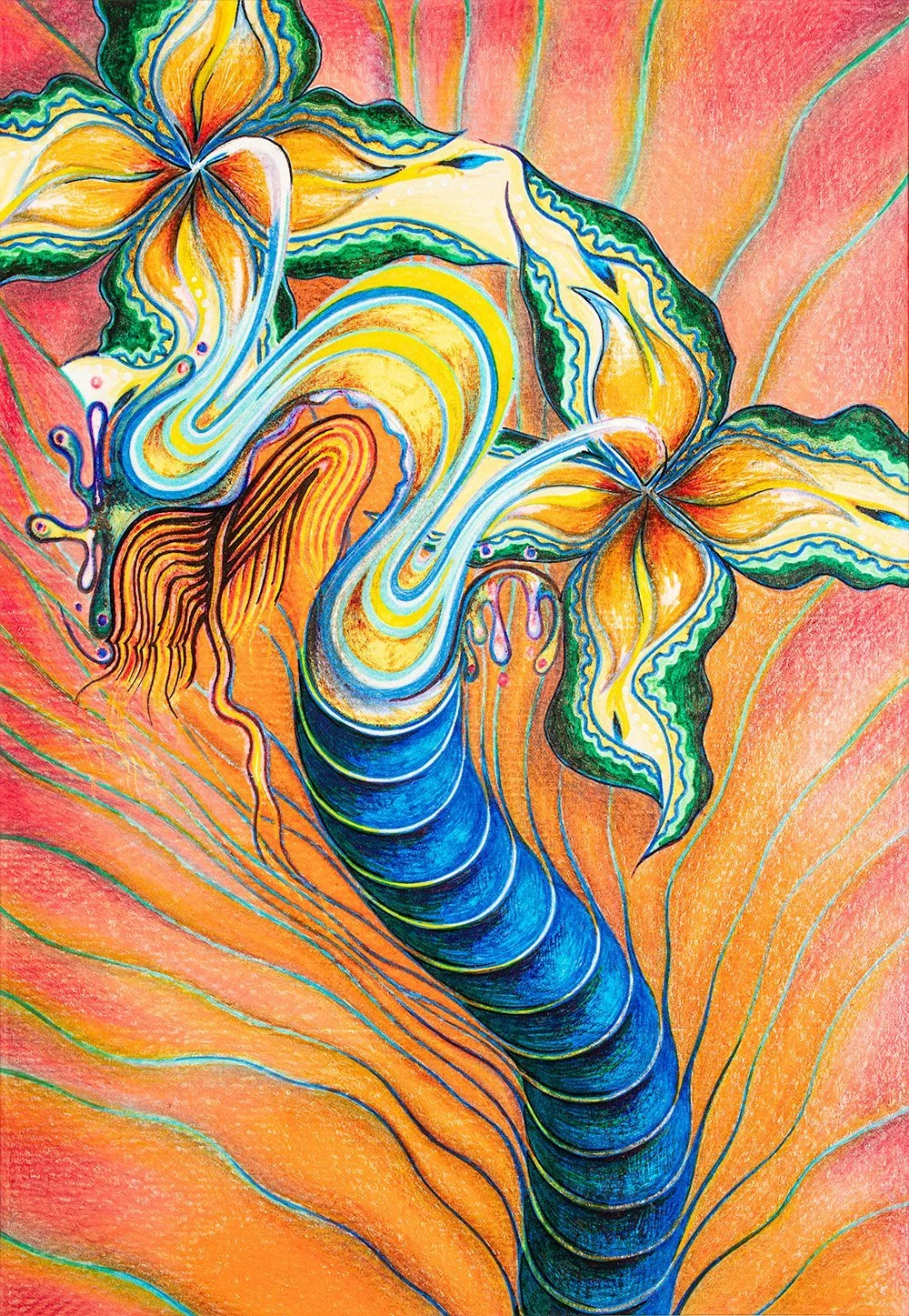
‘Fertile’ - drawing 28 x 20 cm | 2023
The funny thing is that Plato — our well-known Greek philosopher, more or less the only one everybody has heard of, thanks in part to his allegory of the cave — has the comic playwright Aristophanes explain in his Symposium that human beings originally had four arms and four legs, until Zeus (head honcho of all the Greek gods) split them in two and the two halves were left to feel incomplete ever after. They would spend the rest of their lives searching for their other half. 'Soulmates', you'll have heard of those too. Exactly the right person for you, at the level of the soul. It was only a joke, a comic myth, not a serious theory of his — but it does make you think, doesn't it? There are plenty of people who assume that this one person, the one, is walking around out there somewhere, and that once they've found each other they'll finally feel complete and be blissfully happy for all eternity.
We were raised on fairy tales of princes and princesses, which gave us the entirely unrealistic idea that the love of our life is going to hand us our happiness. He'll ride in on a white horse and save you from the dragon, from the villain, out of the tall tower you can't get down from yourself. The princess as a self-sufficient person who determines her own happiness and manages perfectly well without a prince — that fairy tale rather passed me by in childhood. And it works the other way round too, gentlemen, where you're given the idea that you have to be that prince on the white horse. The pressure that puts on you as an ordinary bloke ;-) Where do you get hold of the horse, and the courage while you're at it? The princess who must be beautiful, perfect down to every fold of her gown, and the prince who must be brave and leap into the breach for… They're all expectations that have, perhaps unintentionally, placed a weight on how relationships unfold today. Neither party can live up to it, and still we want the fairy tale, the 'and they lived happily ever after'. Do feel free to scratch your head, because that's exactly what it is: a fairy tale. And everyday life looks nothing like it, with the drudgery of all the dull, regularly recurring things that simply have to get done and about which the two of you are more often than not on entirely different tracks.
Yes — and while you're squabbling about who left the cap off the toothpaste, you're not exactly warming up for a nice bit of intimacy, are you? True or not? So that starts running thin as well (and I'm leaving those mad hormones out of it for now), and before you know it you're looking at each other thinking: 'Is this it? Is this the fairy tale I dreamed of?' Yes, expectations, people — they'll be the death of you.
Apparently marrying for love is, in the whole span of human history, a relatively new idea. That people once wanted nothing to do with it, because love only got in the way of something that was meant to be a business arrangement, or at the very least a practical one. Historian Stephanie Coontz researched it — Marriage, a History: How Love Conquered Marriage — and argues that falling in love is of all times, but that only rarely in history was it seen as the reason to marry. Ha! Yes, romance is what does marriage in. Didn't see that one coming, did you? Neither did I. More than that: anyone who advocated love as grounds for marriage was regarded as a threat to the social order, and in some times and cultures true love was thought incompatible with marriage. Coontz argues that when marriage entered the emotional domain in the nineteenth century, it began to suffer as an institution at the very moment it began to flourish as a personal relationship. So marriage hasn't got worse — it's carrying a heavier load. And you'll find the modern version of that in relationship therapist Esther Perel, who puts it sharply: we ask of one person what an entire village used to provide. Best friend, passionate lover, co-parent, intellectual equal, therapist, fellow adventurer. No wonder the lid rattles sometimes.
I think there's a kernel of truth in that, and that we look for too much in that one person, who could never have contained all of it. Your disappointment will feel like failure to him, and the other way round, while the premise isn't a fair one to begin with. And now for my own question from earlier: how are the neighbours getting on? The anthropologist George Murdock compiled an atlas of hundreds of societies, and it shows that a good eighty per cent of them permitted some form of polygyny. Predominantly men keeping several wives, needless to say. Strict monogamy, on paper, occurred in under one per cent. In practice things looked rather different: even within those societies only about fourteen per cent of men were actually married to more than one woman. The vast majority of marriages turned out to be 'plain' monogamous. The real excesses were found at the top, among the elite. The more powerful and despotic the regime, the more wives that elite kept. Ordinary people were, by and large, monogamous. Well, there you have it. If you've got to worry about food and a roof over your head, you hardly have the time or energy to keep several relationships going, do you? One is complicated enough as it is, especially where equality comes into it. And in nature? Of the roughly four thousand mammal species, only three to five per cent live monogamously in any form. So we belong to a small club, but we're not unique in it.
And as for monogamy in our own time: yes, I'll leave you to form your own thoughts on that. These days there are entire networks facilitating romance outside marriage, and the fact that this draws such large numbers of people shows how great the need is. Whether it isn't simply a search for more of the same is something you might well ask yourself. I don't have the answers to that. What I do know is that my life took on more colour, quite apart from what my partner did or didn't do with me (both in terms of how we spent our time and between the sheets), once I took the room and the time to be fully myself — with, in my case, all the mad, creative, fanciful excesses that come with it. I've given the 'me' who takes everything so seriously a name (on a coach's advice), Laura, and whenever I set the bar too high in my head, for myself and for everyone around me, I say: 'Laura, ease off a notch now. Not all your thoughts are necessarily true, and they don't all have to come true right away either. Stay in the here and now.' Ah well, my dear Laura believes in the fairy tales she's read, and I cherish that in her. She's allowed to dream. And sometimes she bolts. Luckily I'm still here too. And perhaps that's the answer to my one-and-one-is-three after all: that third thing doesn't come from laying two halves side by side, but only once we're both already whole.