
Decades ago now, I was made aware by a pastor from Kansas City who appeared on a television show that moaning, complaining, expressing your dissatisfaction, being pessimistic and/or judgmental actually shapes your brain structure. Certain neurological pathways get worn in, and if you're not careful you keep ending up in the same groove, because of that path in your brain that's been carved out by repeated behaviour. It becomes your hobbyhorse and you'll fall back on it in more ways than one, often without even realising it. This pastor challenged the people of his parish to stop complaining. As an aid, he had made purple bracelets, and every time you caught yourself at it, you had to move the bracelet to your other arm. Until you had worn the purple bracelet on the same arm for 21 days (that's how long it would take to learn a new habit or unlearn an old one, in this case).
Yes, I ordered and wore that bracelet. I vaguely remember never completing the term and being so caught up in life that at the end of the day I'd look at my purple bracelet and have to honestly admit it should have switched sides a few times already. Now I was reading about it again. About that learned behaviour that demands more and more, because it's become such an easy path to walk. A bit like your favourite jumper, because you always wear it and it fits perfectly from being worn so much. But is it really your favourite jumper, or does it just hang at the front of the wardrobe? I had parked the intention somewhere in a notebook, meaning to give it a place in my life soon. Perhaps with a homemade bracelet to go with it. Until a little light went on. Stop complaining, stop moaning — that's not necessarily the most positive approach. What if you flip it and remove the negative? So what do you actually want to achieve? Exactly. More gratitude, contentment.
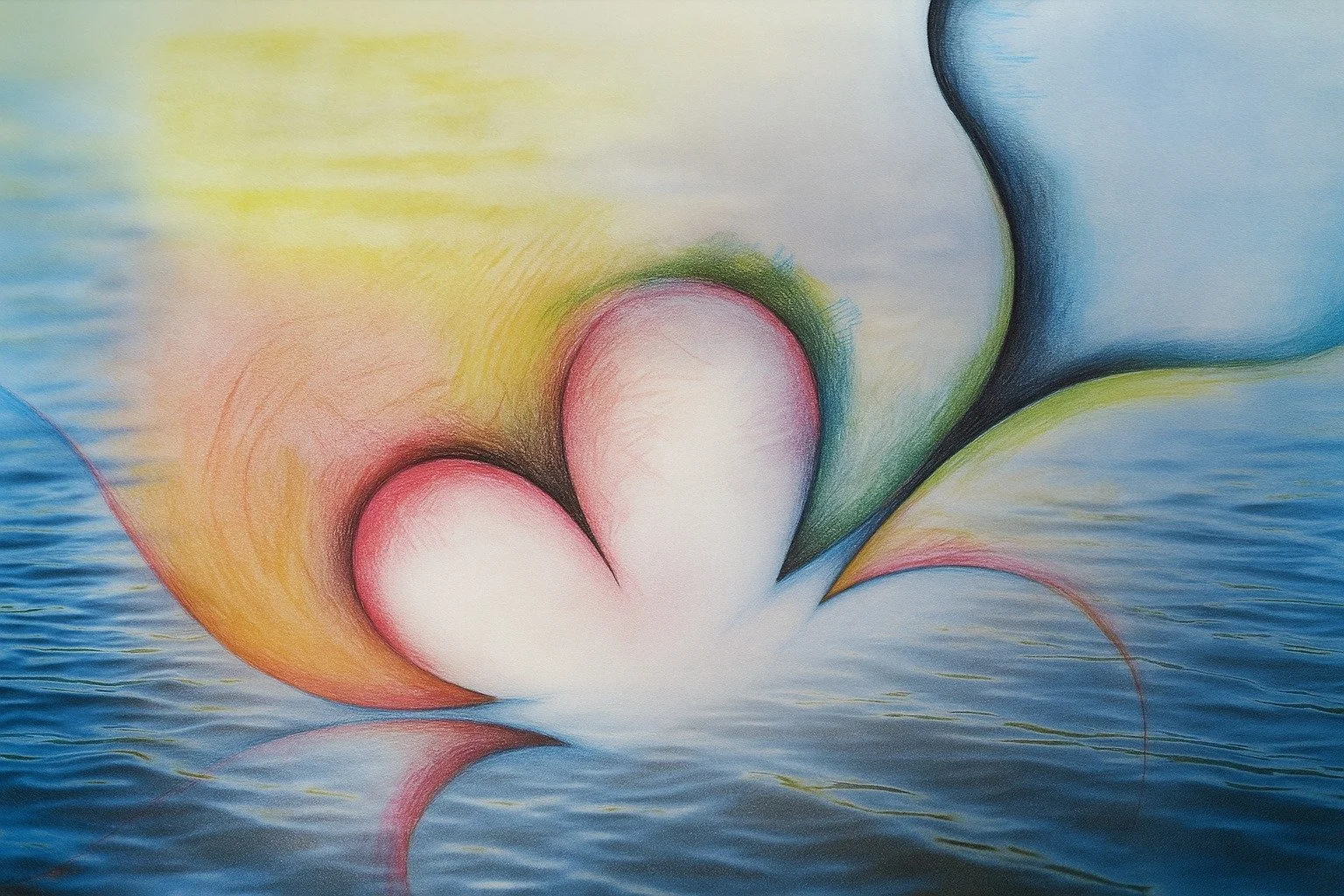
Embraced. Saved. Home.’ — you+me artwork, a commissioned work
You can practise gratitude, and in my case that initially means nothing more than consciously describing three things at the end of the day, in as much detail as possible, that I'm grateful for. And what strikes me now… It's a small revelation, I think. I notice that I turn out to be most grateful for the moments that weren't so easy — messy, with complications — but that in the end yielded something unexpected: think of having learned something, working things out together, or making a discovery. Funny, isn't it? I'm certainly aware of how lucky I am with the people around me, that I love my surroundings, that I enjoy my freedom as a self-employed person, all of that and more. But in the moments when I want to write down something specific at the end of the day, it's that one argument that comes to mind, the one that was unpleasant but ultimately showed me something about myself or about my relationship with that person. Or I realise I've been on a negative track all day. For example, by being too preoccupied in my head with all the hassle surrounding the book — think administration, marketing, things that don't come naturally to me. But when I then open my gratitude notebook, my pen still forms the following words: 'Grateful that the people close to me have bought my book and will take the trouble to dive into my fantasy world. That's pretty special.'
And the greatest gain from these gratitude exercises is that I generally feel better about my day, as if by consciously engaging with it in the evening, I'm unconsciously engaged with it during the day too. And that means that at the moment of writing this (I've been doing it for just under a week) I'm already reaping the benefits of this remarkable and relatively simple concept. I notice I'm looking through a different lens — not that I'm suddenly a transformed person, really not. Yet it simply does me good. Imagine if each of us did this and felt a little bit better about our own situation and about the people around us. What effect would that have on the bigger picture?
According to Robert Emmons (the father of gratitude research and psychologist at the University of California), people who regularly practise gratitude sleep better, have a stronger immune system and are more resilient in the face of adversity. He confirms that it indeed has the effect I'm experiencing: by consciously engaging with it in the evening, it influences the rest of the day. Martin Seligman, the founder of positive psychology, developed the exercise I now do every evening. He calls it the 'Three Good Things' exercise. It's more than just being grateful, because you also describe your own role in it.
Rick Hanson (neuroscientist) describes something that gave me a little knot in my stomach when I read it, namely that our brain holds on to and stores negative thoughts more readily (negativity bias). In practice, this means that negative experiences stick like Velcro and attract more and more negative information. Positive experiences don't have the Velcro effect but are instead as smooth as Teflon. He indicates that if you consciously practise gratitude and pause for longer than 12 seconds on a positive thought, it can anchor itself. Your long-term memory then stores it.
Now, I'm not inclined to burden people with assignments and I'm the last person to tell you what to do, but for those of us who are interested, I've looked up five gratitude exercises. I promise I won't quiz you on them ;-)
Ways to practise gratitude (besides writing)
Gratitude letter — write a letter to someone who has been important to you and read it to them. Seligman calls this one of the most powerful exercises there is.
Gratitude meditation — five minutes a day reflecting on three things you're grateful for, but with your eyes closed, feeling in your body where that gratitude sits.
The contrast principle — imagine what your life would look like without something or someone you currently take for granted. The absence makes the presence tangible.
Gratitude in difficulty — not just being grateful for the good, but actively searching for what a difficult moment has brought you.
Expressing gratitude — not just writing it down but saying it too. To your partner, your child, a colleague, a stranger.
The German mystic Meister Eckhart (13th–14th century) said: "If the only prayer you ever say is 'thank you', that is enough." That seems like a fitting closing thought. Have a lovely Sunday, and thank you for lending me your attention for a moment. ;-)