
Lees deze column in het Nederlands
Xandra Dupper — September 20st. 2026
If you happen to be one of those sunny sorts who walks through the world with nothing but optimism and good cheer in their sights, then this post probably isn't for you. This one is for the people who can be just as happy as they are sad and angry, and who sometimes don't know what to do with the sheer intensity of it. A small sample from my own life, by way of illustration.
A few days ago I was on my knees in a puddle of water in the middle of the hallway, with broken glass all around me as far as I could see. How the glass got there matters less than how I responded to the unrelenting fact of it. Mitigating circumstances? I was tired, I had a cold, I'd had a long day, and I felt as though I already had one foot in the evening's wind-down, since my child was nearly in bed. But no. I wasn't going to be putting my feet up just yet. I was going to be fishing glass out from behind the skirting boards, hunting for a vacuum cleaner that actually worked (quite the undertaking, as it turned out), shaking out towels full of water and glass and wringing them out on a wing and a prayer, and I was going to come apart… Yes. There it is. The simple task of cleaning up broke me on the spot, and once I'd admitted to myself that I could barely keep track of these few straightforward actions, the tears wouldn't stop.
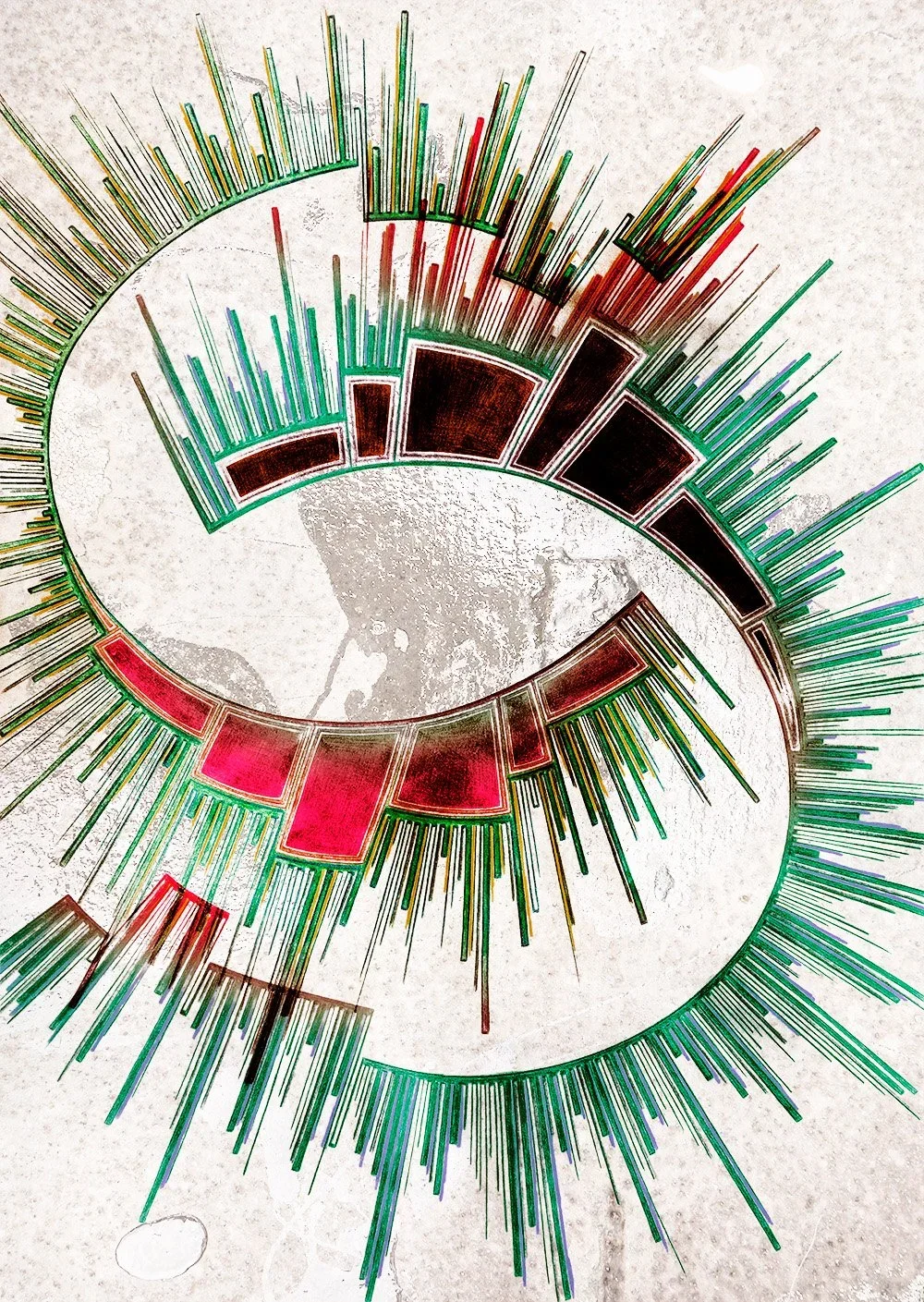
'Fireworks' - digital graph art 39 x 28 cm | 2016
I have to be honest. Emotionally I've never been the steadiest, if I compare myself with the people around me. Now, everyone has their own coping mechanism, and being affected isn't equally visible in everyone. But with me it is. I am, as the saying so nicely goes, an open book. When I get angry I can't quite keep my voice under control, for instance, and once I'm sad the waterworks run down my cheeks like little rivers — the water is barely to be dammed, and the sorrow just as little. I feel it down to my toes.
And I certainly don't want to blame everything on hormones, but it is striking that this hasn't improved now that I'm working my way towards fifty, and that I'm regularly overwhelmed by the whole colour palette of my emotions. Almost everything seems to reach me. It's one of the reasons I no longer watch the news. I'd never stop crying — that is, assuming I could get past my anger in good time.
So. The weight is on the table. On yours now too, though perhaps it was already there. We all have our crosses to bear, I'm told.
So what can we do to keep our emotions manageable? Of my exuberant cheerful spells I have remarkably little trouble, I should say — because those exist too. It turns out that managing them, according to the Buddhist tradition, isn't the right approach at all. Equanimity, rather. What a beautiful word, don't you think? The word the Buddhists use is upekkha, which literally means to look upon or to look over — but equanimity catches it far better. Because it isn't about indifference. It's much more about standing firm in the face of the swings of fortune that come to every human being. We may feel powerless about what life puts on our path, but the point is to meet it, and to stay even-minded in the face of gain and loss, honour and dishonour, praise and blame, pleasure and pain. Indifference would be the wall you build so you don't have to feel. Equanimity, by contrast, doesn't keep you away from the feeling — but it doesn't drag you off with it either.
(A note for the English ear: our Dutch word gelijkmoedigheid has courage buried inside it — moed. Yours has evenness: aequus animus, an even mind. Same virtue, two different promises.)
The opposite of what you're after is always easy to spot, and in the Buddhist tradition it's called the far enemy. But the near enemy wears almost the same coat as the virtue itself, and is sneakily just not the helpful thing. The near enemy of equanimity is indifference — and being one of those sunny sorts might well be precisely that. Then again, perhaps you simply got lucky, and life is there to serve you and your interests. That's possible too. It isn't my lot, at any rate.
Equanimity. Being even-tempered about whatever falls to you, whether that's good or bad. Truly a lovely word, isn't it? It asks for a sharper attention than almost any other state of being, because the pleasant and the unpleasant both demand that you not be pulled under by either. Equanimity isn't the end of feeling, but the condition for feeling clearly. I never knew this word held such a fine balance in it, and that in principle it's enormously demanding. Sharp attention isn't exactly something that comes easily to us, not when you look at how eagerly we embrace the lure of distraction, in rather more ways than one. Now that I know what I'm aiming for, I also understand better how I drifted further from it every time I picked something up in order to forget, in order not to feel, in order to be busy with something else. That isn't equanimity, that's flight — and flight is indifference. The near enemy, then.
And what do you know? Managing, which I'd taken to be a fine plan — that is, suppressing, which amounts to keeping your face straight, keeping your voice under control, not letting on that you're affected — is regarded by modern psychology as one of the least helpful strategies going. Inhibiting negative emotions is considerably more demanding and more physiologically taxing than not regulating at all, and it's associated with greater sympathetic activation, more negative affect, anxiety and low mood. Acceptance, oddly enough, does the reverse. In experiments, people who took that approach tolerated more pain, were less afraid, and had fewer catastrophic thoughts. Now, you can't map that kind of research one-to-one onto your own reality, and everything is context-sensitive — take that with you as well.
Matthew Lieberman has shown that naming your emotion, as specifically as possible, helps you regulate it. Not that the emotion disappears, but the intensity recedes somewhat and it becomes easier to deal with. It's no coincidence that I write this blog, and that it comforts me to be able to find words for my experiences and then share them with you. Finding kindred spirits, not being entirely alone in it, plays its part in that comfort too, of course. The better your vocabulary for the various emotions, the easier the regulating. Being sensitive has, in my case, come hand in hand with the words to carry that sensitivity. Fortunately.
A selection from the emotional vocabulary, for when you need it. (How delightfully at odds with my previous column, Language as Reality.)
downcast · dejected · despondent · crestfallen · forlorn · wistful · melancholy · heavy-hearted · heartsick · sorrowful · rueful · woebegone · bereft · desolate · disconsolate · grief-stricken · hollow · bleak · homesick · adrift · irked · nettled · peeved · piqued · testy · tetchy · prickly · cross · irritable · exasperated · indignant · affronted · riled · incensed · irate · livid · seething · fuming · apoplectic · resentful · embittered · rancorous · begrudging · uneasy · disquieted · apprehensive · wary · leery · jittery · edgy · antsy · skittish · daunted · cowed · fearful · dread · foreboding · trepidation · misgiving · panicky · petrified · startled · jolted · taken aback · blindsided · stunned · floored · thunderstruck · dumbstruck · flabbergasted · nonplussed · shaken · content · cheerful · chipper · buoyant · blithe · lighthearted · heartened · gratified · fulfilled · gleeful · giddy · elated · jubilant · exultant · rapturous · euphoric · blissful · serene · tranquil · hopeful · expectant · sanguine · optimistic · buoyed · trusting · resigned · reconciled · at peace · unclenched · fond · tender · affectionate · warm · doting · devoted · cherishing · smitten · besotted · enamoured · compassionate · moved · touched · softened · grateful · yearning · longing · pining · aching · ardent · envious · covetous · jealous · grudging · slighted · possessive · sour · sheepish · bashful · self-conscious · abashed · chagrined · mortified · humiliated · contrite · remorseful · guilt-ridden · exposed · curious · intrigued · fascinated · enthralled · rapt · spellbound · awestruck · wonderstruck · marvelling · dumbfounded · overwhelmed · overstimulated · frazzled · frayed · wrung out · spent · depleted · drained · wiped out · numb · deadened · listless · languid · enervated · flattened · unmoored · at sea · hollowed out · threadbare
That day on the floor, among all the glass, I felt humiliated, flattened, blindsided, bereft and despairing. I'm probably missing a few. As I write this I feel relieved, curious, fascinated, devoted, grateful, cheerful and content. And this morning, when my husband put his arms around me while I was making lunch, I felt loved, softened, blissful and fulfilled. It's funny how often I get pulled up for being long-winded — and it turns out that for regulation it isn't such a bad thing at all. Be a little more long-winded, dear people, in the moments when the emotions get to be too much.
And as ever, the thread running through it is this: how good that we can bring a little more understanding to it, thanks to the old thinkers and the wise spiritual guides — but don't overdo it. I have a habit of that. Wanting to be perfect at equanimity is simply not very equanimous.