
Our family dynamic has changed since my father-in-law passed away, and these days we sit at the table during meals with my mother-in-law, Henny, who now lives with us. She's had two TIAs and developed aphasia as a result, which means she can no longer find the words for the thoughts she has. There's plenty going on inside her, but expressing herself properly just doesn't work anymore. We get by with yes/no questions and that takes us quite far, though that's easy for me to say from my side of the story. She doesn't seem frustrated, more resigned, and what strikes me is that she moves forward with remarkable contentment, even gratitude.
But what happens when you regularly have someone around you who doesn't speak and merely observes? When that person uses her facial expressions to let you know whether she feels good about a situation or not? So there you sit, peacefully at the table together. I can still bring up some practical topics of conversation, I keep her up to date on everything that's going on, but a deep conversation isn't going to happen. So we look at each other now and then, smile with understanding, and disappear back into our own heads.
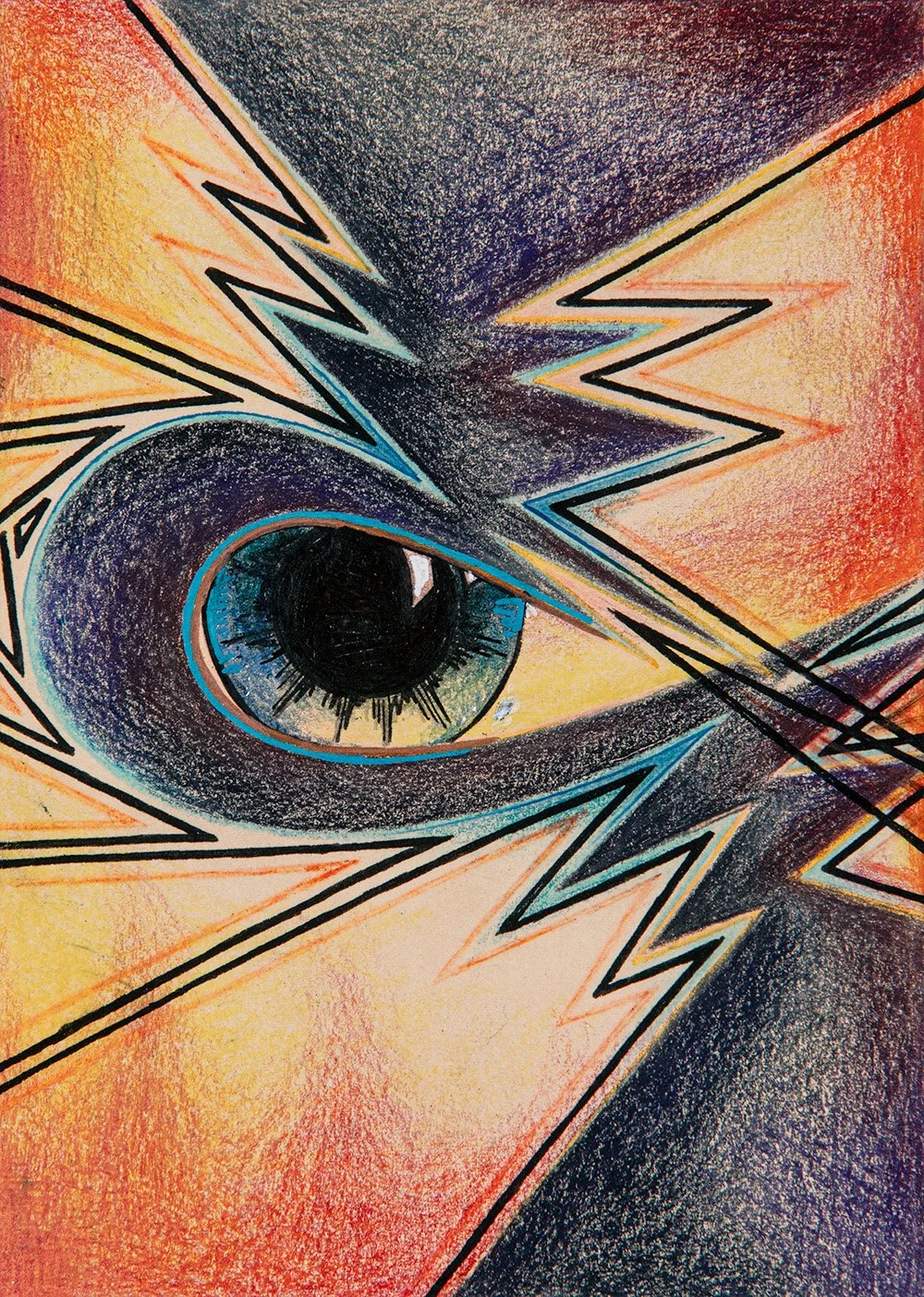
‘Dali’ - mixed media | 14 x 10 cm | 2024 | artwork from ‘Omaria’, first book in the series The Night Travellers
She often reads a newspaper. By the time she's had her home care treatment and comes downstairs, I'm well into my work. So there I sit with my laptop in front of my face. She's then stuck with the kind of person who stares into her glowing little box, busy at work, furrowed brow and all. Quite a strange situation, really.
I try to imagine how that comes across to her — a daughter-in-law typing away for queen and country on her keyboard, morning after morning after morning. Every now and then I tell her briefly what I'm working on, so she feels involved. But not just for that reason. Much more because otherwise I feel so silly. Sitting behind a computer in her presence feels like a mindless activity, as if I should have something better to do. So I'd rather do the laundry when she's around, or cook, tidy things up. Then I simply look more industrious.
Having eyes on you, whether consciously or not, clearly has an effect on me. Her presence makes me look at myself from a distance and wonder whether what I'm doing is meaningful (or at least looks like it).
I don't know if everyone would handle it the same way. It's the Big Brother is watching you effect, and there are in all likelihood both positive and negative sides to it. I won't be leaning back and picking my nose any time soon with my mother-in-law around. My kid did exactly that in the middle of a restaurant recently, mind you. So this is clearly age-dependent. He's capable of being his complete little self, regardless of who's watching.
As I write this, I'm reminded of George Orwell's '1984', in which he describes how people live under constant surveillance with strict behavioural rules they must follow. The protagonist, Winston Smith, was even able to control his facial expressions so they wouldn't be picked up by the cameras. The ultimate 'not being yourself' is expressed in that book. Authenticity melts like snow in the sun when you know someone is watching. Orwell exposes what it does to your inner life. At a certain point, Winston can no longer distinguish his own thoughts from the thoughts imposed on him — this is how you're supposed to behave — and all because he's constantly aware of the critical gaze bearing down on him through the screens.
I recently read online that there are now glasses and earbuds (Meta Ray-Ban Smart Glasses) that look perfectly normal in the street but can record you without giving any signal — both image and sound. We've all seen a science fiction film where something like this is presented and seems impossibly far removed from reality. But we're already there, or at the very least very shortly, if this article is to be believed. The thing is, you don't even know you're being watched. In any case, more and more cameras have appeared in the streetscape and a doorbell is no longer just a doorbell these days. We're being watched en masse — by each other, no less. How does that feel? What do we do with that? What does it do to our behaviour?
Jeremy Bentham designed a prison concept in 1785: the panopticon. A circular prison where one guard in the centre can see everyone, but the prisoners can't see whether they're actually being watched. The result: they behave as if they're always being watched. Michel Foucault picked this up in 'Discipline and Punish' (1975) and turned it into a metaphor for society as a whole: we internalise the gaze of the other. We don't actually need to be watched — the idea that we could be watched is enough to make us adjust.
But what are we adjusting to, and what is the judgement of the one watching? If I can't easily see eye to eye with my partner in an average conversation, then that's unlikely to be any different with an unknown voyeur. They may have a different worldview than mine, different political preferences. And what if my perspective is different but gets disapproved of by the person watching and judging me? In Henny's case, I know her gaze is empathetic, that she's simply watching and at most raises an eyebrow now and then, without that needing to mean anything to me. But in China they have a functioning credit system, and if you fall outside the norm they can freeze your money or ban you from travelling by train, to name just one example. I have no idea what the penalty for nose-picking is and to what extent children are included in this system… Don't we learn from making mistakes, especially through self-correction? Isn't that part of human development, the path we walk here? What if you take all responsibility away from a person? What if self-determination no longer needs to be learned and you simply have to do what's expected of you? Could that really be the intention of this exercise here on earth — given that we were granted 'free will'?
The illustration used is one of four that form the basis of the book ‘Omaria’ from the series The Night Travellers. But in this case, the image works perfectly as ‘the all-seeing eye.’