
‘How time flies!’ I can’t recall ever having those words in my mouth as a twenty-year-old. Now I feel them on the tip of my tongue at every turn. I still don’t use them — they don’t quite cover it, to my mind — but I do say things along the same lines, mind you, like: ‘Where did the summer go?’ or ‘Is that child really ten already?’ ‘Time does a number on you.’ Exactly — the English have a more fitting expression for it once again. That certainly holds for my experience of it. Time plays tricks on you, pulls your leg, the moment you’re not paying attention, and pfooeeh, off it goes — time you can only look back on as a memory. Then again, you can also be stuck in time. That happens to me just as often. The moment simply refuses to pass. Rather clichédly, you then start to think you must not be enjoying yourself. ‘Time flies when you’re having fun!’ But that argument doesn’t quite hold water. It isn’t only tediously arranged time that creeps forward like a snail. It’s more the unpredictable character of time, and the individual experience of it, which can differ enormously.
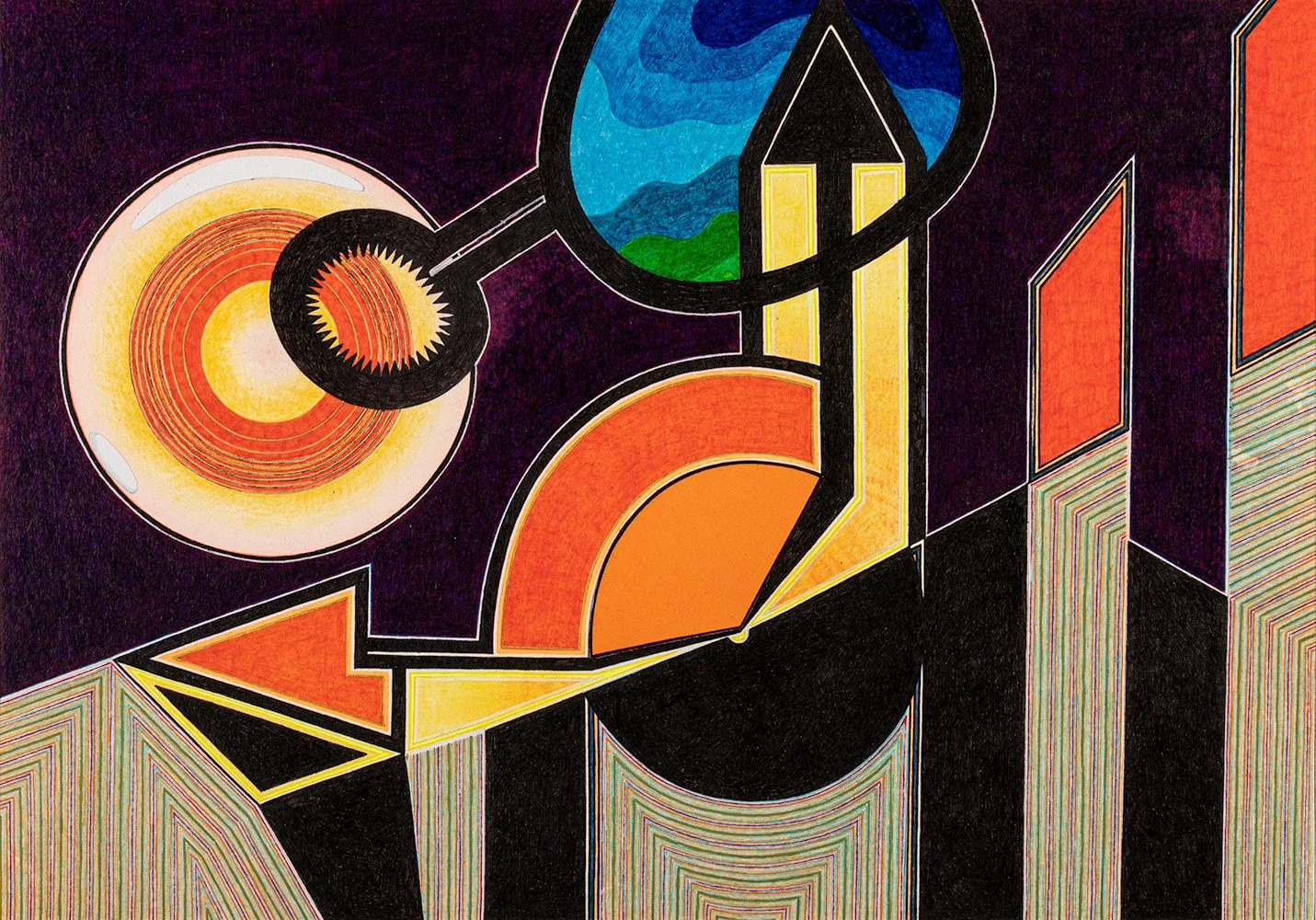
‘Doctrine of Time’ - mixed media 29,5 x 42 cm | 2020
Time can also feel like a straitjacket, an imposed system that gives rise to all kinds of obligations, deadlines, so-called rhythms dictated purely by the clock. ‘Late…’ feels fundamentally disappointing… you, as a person, failed to keep an eye on the time. Oh yes, that fact in itself is also a thing, as far as I’m concerned. Are we really meant to be keeping an eye on time? It sends you straight into a cramp. But there are people who get quite worked up, or at least quietly form an opinion, if you happen to be the sort who regularly lets time slip by without any awareness of it. Now you’re thinking: that Xandra is one of those. That maladjusted dreamer just leaves everyone hanging in time. Because that is what it comes down to when you turn up late and then go on wasting someone else’s time as they wait for you. Well, no, actually. Not that it never happens to me now and then, but when it does I feel genuinely bad about it. No, I’m one of those types who arrives early rather than late and then wastes my own time waiting. Sadomasochism, that’s what it is. What makes another person’s time more precious than mine? I ask you ;-)
But seriously now. We’re well and truly saddled with time, and with its passing too. It makes transience possible (and how we loathe growing older), the turning of the seasons (to everything there is a season — so that includes autumn, dear people…), the growth of awareness and consciousness (ignorance is bliss, or so they say). Now it sounds as though I’d rather pour time down the drain, good riddance… But more than that, I wish I were allowed to experience time less rigidly.
Joke Hermsen (1961), novelist and philosopher, has written a fine book about it: ‘Stil de tijd’ (Still Time), in which she sets clock time against inner time — that is, your personal experience of time. A little book well worth your while, in my view, especially if you want to explore how to seize time (by the forelock) at the most opportune moment. And when is that, you’re probably wondering, or how do you find out? Kairos. That’s what I’ll leave you with, along with plenty of reasons to go and read Joke if you truly want the answer. A small lifting of the veil… In the West, chronos — the objective, universal, mathematical time of equal units — has driven out kairos. Time is money. Hermsen therefore makes the case for kairos, time as ‘the right moment’, because we no longer get round to rest, boredom, attentive listening, and unhurried waiting — precisely what is essential for letting in the muse and letting creativity bubble up.
Once before, in the reflection ‘cyclical living’, we mentioned the Japanese, who had a seasonal time system. (Note the past tense.) Their day was divided into twelve parts (toki): six from sunrise to sunset, six from sunset to dawn. Because the summer day is long and the winter day short, the length of each hour differed by season, which meant a summer daytime hour lasted longer than a winter one. Japanese clocks, known as wadokei, were ingeniously adjusted because the length of an hour changed every fortnight. In the end they too fell into step (that is: adapted to Western standards). Now they pride themselves on their punctuality, and it’s taken as a mark of good character. Which just goes to show how culturally determined our experience of time is. One emperor out, another in (with contacts across the border, evidently), and hey presto — different values, different customs. To me, it says enough about how important it is not to make your own experience of time subordinate. Don’t let yourself be driven by the ticking of time (you know those mechanical clocks that drive you utterly mad with their relentless tick?). The inner clock is what you may steer by; all the rest has been erected for us so that together we become a well-oiled engine that can be counted on.
Augustine (Confessions, book 11) concludes that time is a ‘distension’ (distentio) of the mind: only the present exists, yet the present itself has no duration. He resolves it with three presents: ‘the present of things past’ is memory, ‘the present of things present’ is attention, and ‘the present of things future’ is expectation. What we measure is not the outside world but the impression things leave in us — ‘it is in you, my soul, that I measure times’. And he describes time as a painful fragmentation of the self: ‘I am scattered in times whose order I do not understand.’ What a remarkable view. Time as a painful fragmentation of the self points to our own part in it, something at odds with itself, and it touches precisely on my ‘being stuck in time’ and my ‘how time flies’. Time is subjective and lived from within, not on the clock face.
There are so many more ways than one to approach time, and it’s a phenomenon many a mind has bent itself over. Even so, I’ve made him (or her — you tell me) my friend. ‘Time heals all wounds’ is true, after all. ‘Give it time’ is one of the finest principles I’ve given myself as a gift since I flew past forty and, with every year that passes, feel more and more calm settle into my body. It does wondrous things to me, time does, provided I handle it consciously. ‘Having time to yourself’ is where the moment can be stretched and small lights go on in my head, ideas take shape. It’s no coincidence that the best plans are hatched during a trip to the loo, in the shower, or on a long walk. That’s precisely where time is taken (obligatorily here and there, if it happens to be a long sit ;-) And that’s where silence and space let a person’s creative power come into its own most fully. That’s also where ‘time’ becomes a gift I embrace completely and draw on to the last drop. And whether that time is yesterday, right now, or tomorrow on the calendar is beside the point for me — as long as it was mine to join in with as I pleased, and to make my own.
What if you could stretch time, speed it up, expand it? On ‘Omaria’ (the Night Travellers series) this is possible — and more… Do you dare?