
Why is one week never the same as the next, as we so beautifully put it? I don't know how it is for you, and I hope the men among us aren't already looking for something else to do because the cycle doesn't concern them — but nothing could be further from the truth, gentlemen. The simple fact that you regularly deal with cyclical beings (women) should be reason enough to sit on the edge of your seat right now. On top of that, I dare to claim it concerns you just as much, albeit a little less obviously.
Once upon a time, hundreds of years ago (1582 to be precise), Pope Gregory XIII decided we needed to get our days, weeks and months in order, and a calendar year was created. Oddly enough, the most obvious factor wasn't considered: the when of the sun rising and setting, plus the phases of the moon. These two impactful celestial bodies were partly pushed aside and the count was, in their eyes, 'logically' established — geared towards the agricultural year and later the church holidays. Easter had to fall on the right day, naturally.
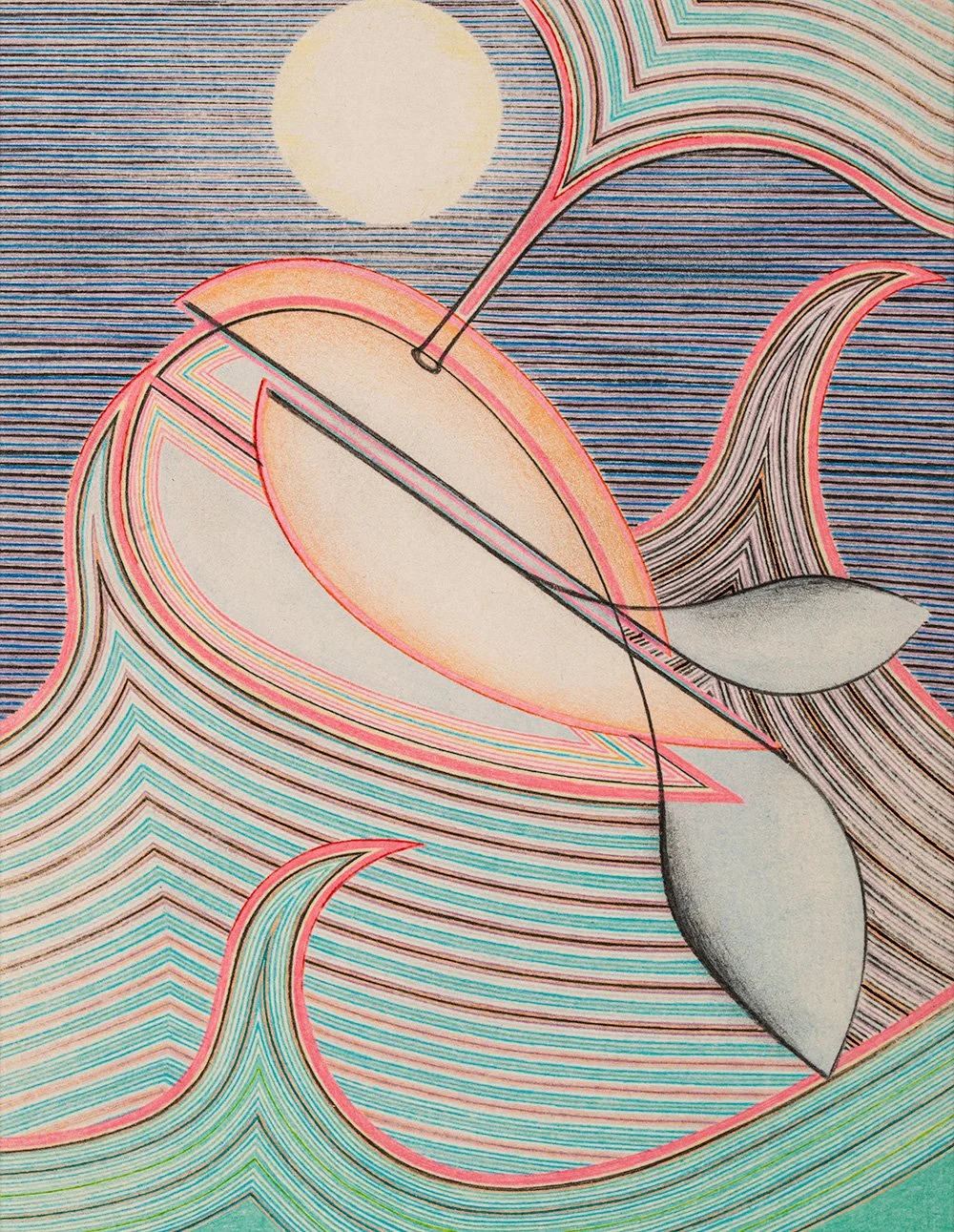
‘Breathe’ - drawing | 27 x 21 cm | 2022
But we clearly can't make it work with this so-called count. They couldn't before either, which is why the calendar has been replaced twice: first Julius Caesar's version (which was 11 minutes and 14 seconds too long, causing the seasons to shift) and before that the Roman calendar. Even now we have to pull a strange stunt twice a year with summer and winter time, and let's not forget the utterly absurd leap year once every four years. Even with all this tinkering we're still not quite in sync with nature. The Maya clearly did look around them and didn't completely alienate themselves from the nature surrounding them when they decided to create a count that produced thirteen months of 28 days, synchronised with the lunar phases. Thirteen months and one day "outside of time" (the Tun Uc).
What we're all doing turns out to be extremely unnatural. We've developed a work-life rhythm based on production needs (first agricultural, then industrial and now automated) and we adjust our natural rhythm to fit. A woman unfortunately can't get around her cycle, though it's stubbornly attempted, because otherwise she can't keep up with that notorious work-life rhythm. I can already see the manager raising his eyebrow: 'What do you mean, you have your period and won't be coming in today and tomorrow? What do you mean, taking a step back because your body is working overtime?' We live so systematically that listening to our bodies is not only something we've unlearned, but something that's been made undesirable, because it doesn't fit the structure we've created.
It starts as early as primary school, where as a child you're required to show up five out of five 'work' days, unless you're ill. And being ill doesn't include having your head elsewhere or feeling like you'd rather be outside. Can you picture it: 'Miss, I'm going to jump ditches today. The weather calls for it. Tonight when it's cooled down, I'll read that book and do those sums.' We don't move with what's happening around us. We use our diary as our guide and everything must fall in line. 'Let's pull out our diaries,' as if it were a pistol.
I noticed recently during a sort of evaluation meeting that I was quite cheerful and looking at the future with a healthy dose of optimism. I'd gained some lovely insights and what could possibly stand in my way? Well, a week later there was literally still nothing in the way and yet my mindset had turned almost 180 degrees. I wasn't cheerful at all, not positive. I even struggled to get through the day and find enthusiasm for any kind of future (I'm laying it on a bit thick). What had actually happened in the meantime? Absolutely nothing. Or had it? Yes, physically there was quite a lot going on. Because that particular gloomy day ran exactly in sync with the days before my period. Physically I was in standby mode. I was getting ready for a few days of internal housekeeping, and those are tough days.
It turns out our cycle can be divided into four phases and they each ask something different of us, of our environment and even in terms of diet. We're just not aware of it and treat every phase the same, because that fits better in the diary. And yes men, it's true, because guess what… in a relationship with a woman (those are those crazy beings you don't understand half the time) you are hormonally influenced by 'her' cycle and so in effect the same applies to you. Oh, how annoying that women's influence reaches so far. Can you believe it! ;-) Anyway, attention please, men and women alike.
The four lunar-menstrual phases
The menstrual phase (day 1–5)
- Hormones: oestrogen and progesterone are at their lowest
- Energy: low, introspective, need for rest
- What the body asks for: withdraw, reflect, let go (literally and figuratively)
- Nutrition: warm, nourishing, iron-rich — beetroot, dark leafy greens, soup, but also: red meat (iron!), bone broth, eggs, oily fish such as salmon or mackerel. The body is losing iron and needs building blocks. This is not the time for light and raw.
- What you should be doing (but probably aren't): resting, gentler movement, journaling
Follicular phase (day 6–12)
- Hormones: oestrogen rises, FSH stimulates the follicles
- Energy: building, creative, curious, fresh
- What the body asks for: starting new projects, brainstorming, social activities
- Nutrition: light, fresh, fermented — plus: chicken, fish, eggs. Lighter proteins that support the building energy. Healthy fats from avocado, olive oil, nuts.
- This is the “projectifying” phase — this is where the energy to begin lives
Ovulation (day 13–16)
- Hormones: oestrogen peaks, LH surge triggers ovulation, testosterone rises briefly
- Energy: at its highest, social, communicative, confident
- What the body asks for: collaborating, presenting, networking, having difficult conversations
- Nutrition: raw, light, lots of vegetables and fruit — plus: fish, seafood, lighter meats. Fat needs are lower here but protein remains important. This is the phase where your body needs the least heavy load.
- This is the moment for deep conversations and special events
Luteal phase (day 17–28)
- Hormones: progesterone rises (prepares the uterus), oestrogen drops
- Energy: still good at first, then declining. The last days are the hardest
- What the body asks for: finishing what was started, tidying up, organising, turning inward
- Nutrition: complex carbohydrates, magnesium-rich — plus: oily fish (omega-3 against PMS symptoms), eggs, dark meat, full-fat dairy, butter. The body is preparing for menstruation and needs fats and proteins to produce progesterone. This is the phase where your body literally craves fat and chocolate ;-)
- This is the phase I described, where those last two days felt like a 180-degree turn — in other words: the feeling of not being able to get through the day (and therefore not the moment to make important decisions)
And when your cycle stops? Women who no longer menstruate — due to menopause, surgery, or the pill — no longer have an internal monthly marker. But the body remains cyclical. You can go in search of that rhythm within yourself, even when your body only whispers it.
All in all, we've strayed considerably from this cyclical way of living. And shall I tell you something strange?
Our year originally didn't begin in January at all, but in March.
The Japanese in earlier times had flexible hours. An "hour" during the day was longer in summer (more daylight) and shorter in winter. And at night the reverse. Time adapted to nature, not the other way around. They had special clocks — wadokei — with adjustable hour markings that were changed per season. Time was literally cyclical and fluid.
And we women no longer run in sync with the lunar cycle since the introduction of artificial light and screens.
What if I were to take my cycle more into account — what would that look like? Can it be fitted into our calendar, our diary? Can we bend our system a little towards our nature instead of the other way around? And as I open my diary, reality starts seeping in… I'll have to pull a Gregorian trick and flip everything in one go, or… or I give it a bit of time and do it very gradually… what if I let the moon speak, then it quickly becomes clear. The moon never does anything drastic, but always very gradually…
As of this week, Omaria is also available as an e-book — and, brand new, in English translation. Both editions (EPUB, € 14.50) can be ordered directly from my own little store at xandradupper.nl/store-en, where a free preview awaits anyone who'd like to taste the night air first. Travel gently — see you on Omaria.