
In conversation with a friend last weekend, the course of our talk reminded me once again of the why behind these personal reflections that I subsequently land on your plate. I have my doubts on a regular basis, you see. I'll have thoughts along the lines of: 'What are people supposed to do with this and why would I make myself so vulnerable and bare my heart and soul?' As is often the case in my life, the puzzle pieces fall beautifully into place and during my search for inspiration for yet another personal story, I find a fragment that does it full justice. Written during Covid times, just for context. Turns out I've known why for quite some time...
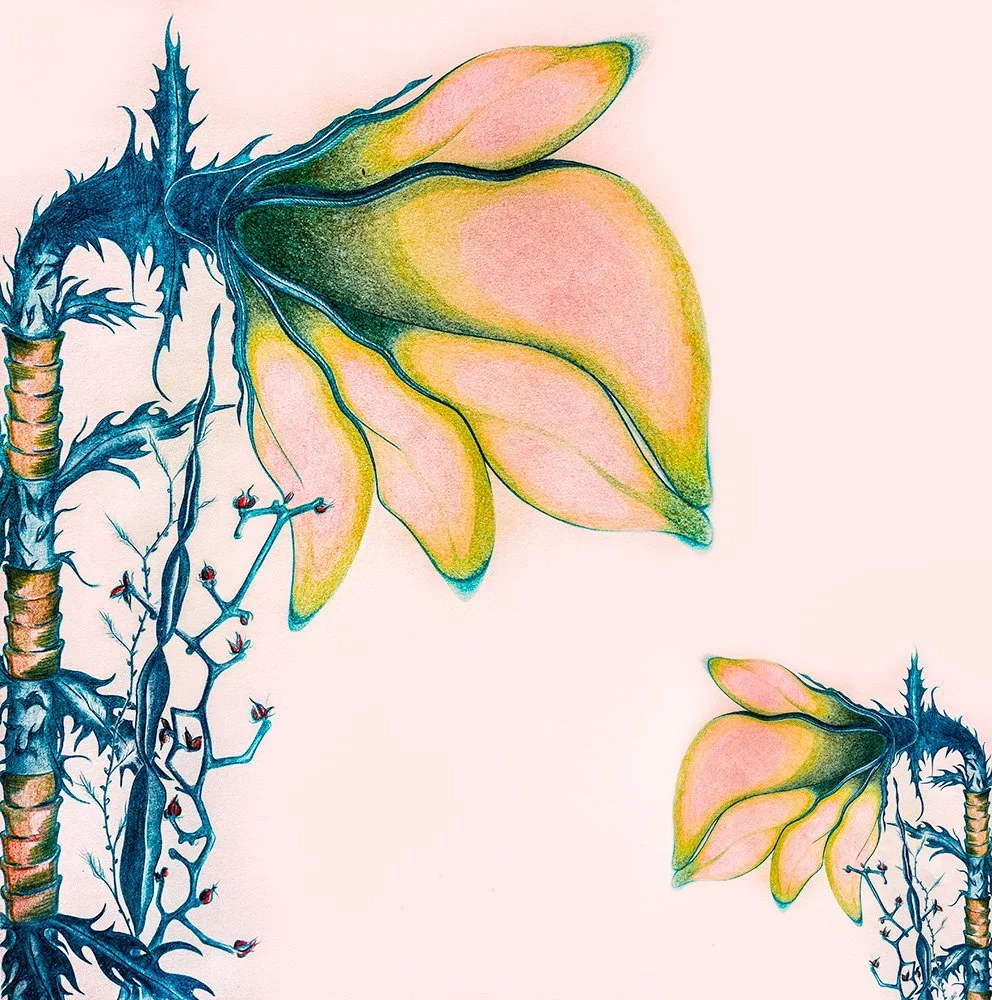
‘Fragile’ - digital graph art | 25 x 25 cm | 2016
“The day has evaporated and in the light of the moments that already lie behind me, it feels as though I'm wasting time. The seconds tick away and I'm so acutely aware of how precious they are and how little respect I pay them. The constant looking back with resignation and reacting indifferently to what I've left behind has no longer been possible since my little man introduced himself, three years ago. The nostalgia is now palpable in every moment I leave behind and I'm wistful daily because time moves so fast. I cling to every minute, every fragment, every conscious awareness of and interaction with him. I look deep into his eyes and realise that the innocence has left me and crept into him. Apparently you pass that on — that sense of things being a given. The idea that you'll be taken care of no matter what, that someone is always there for you and that time is on your side.
As a parent you suddenly become entangled in the struggle between offering safety and giving the freedom to explore life. You can no longer pretend it'll all work out, because you now suddenly hold the responsibility and never realised that something of this magnitude already existed before. Never before had I realised that my parents knew the same kind of worries for me and let me go into this mad, crazy world where nothing seems to be what it is. How do you prepare someone for that? And does it ultimately just come down to letting go and having trust? Is love truly the only thing you have to offer, unconditionally and fully? (Even though appearances can be quite deceiving on the moments you'd like to stick the little creature behind the wallpaper.)
When my father was still alive, I was unconsciously in essence doing nothing other than trying to make him proud. And the funny thing is that I now hope for the same from my little one: that he'll be proud of me. That when he's grown up he'll think I did well as a mother and that he did indeed feel safe and loved during the years he had his home with us. And as I look at myself and how much gratitude I've shown my parents, I realise I'd be mad to think he'll ever express feelings of that magnitude and nature. That's not what children have to offer, and parents don't either, I've discovered along the way.
You can only be content with yourself by making the best of yourself and learning from your mistakes, time and again. A person is a work in progress and it never stops. Progressive insight, again and again and again. Life is a school and I've certainly not finished learning, so the perfect parent I will not be, and I shouldn't want to meet that expectation. It can only lead to disappointment.
What can I do then? What do I value most and how can I express this in my family, outwardly, but certainly also inwardly? It's important to keep asking myself how I want to continue to develop, to fulfil myself, because this underpins everything else. My imperfections may be visible and open for discussion. We can all learn from that. This is one big experiment, this life, isn't it? So let's get the most out of it and be honest, open about all the moments when we fall flat on our face. The countless situations in which we fall far short of our own ideal image. The moments when our humanity is visible. (…)”
And that's precisely the heart of it. Vulnerability. Not as weakness but as strength.
Brené Brown, research professor at the University of Houston, became world-famous with her TED talk 'The Power of Vulnerability', partly because she gave very personal examples and truly dared to let herself be seen. She believes that vulnerability is a great asset and the opposite of weakness, but in fact lies at the foundation of innovative thinking, creativity and ultimately change. People feel most connected to each other, she concludes, when both embrace their vulnerability. And I can only agree, because the risk and the threat fall away when the other person also dares to be vulnerable and dares to show that he or she is not perfect. You don't first make yourself vulnerable only to then tear someone else down and judge them. You create a safe environment for the other to show themselves fully. It's a form of bravery that I regularly talk about with my son. True courage arises the moment you dare to show your imperfect self and thereby give the other person that chance too.
The friend I had such an interesting conversation with last weekend mentioned the German trauma therapist Gopal Norbert Klein. I hadn't heard of him before, but how he sees things connects seamlessly to this theme. He developed a method he calls "Honest Sharing": honestly sharing with others what's going on inside you, without receiving advice, judgement or a reaction. Showing yourself fully — vulnerable, unfinished, imperfect — would allow your nervous system to calm down. What matters is being seen without judgement. This would bring your nervous system out of its permanent state of alertness. This means that alongside psychological benefits, there are also physiologically positive effects. Your body responds to authenticity.
The British child psychologist Donald Winnicott introduced the concept of the "good enough mother" (later expanded to "good enough parent"). And he has completely made my day. He maintains that a child doesn't need a perfect parent. He even dares to claim that a perfect parent would be harmful, because the child would never learn to deal with frustration and disappointment. A "good enough" parent makes mistakes, repairs them (that part is important), and thereby shows the child that mistakes are part of life. So I may freely practise imperfect parenting, because as I wrote earlier: I can't meet that expectation anyway.
In the piece 'Grateful' I discovered that the most valuable moments are often situations with frayed edges and complex protrusions, but where a discovery is made, where growth happens and where progressive insight is possible. Playing the perfect person is certainly not going to help with that. We don't say 'you can learn from your mistakes' to our children for nothing, and this applies to us adults too.
So let me, beautifully imperfect and as a fully vulnerable being, enter into this interaction with you. Completely authentic and as myself. Yes, plenty to criticise, I know, but courageous all the same. As far as I'm concerned, the adventure called life becomes a lot more interesting this way. I hope so for you too.