
ADHD | ADD
I’ve decided to take the bull by the horns, because there’s no getting around it anymore. The media are full of it, at our house it’s the topic of conversation, and on the playground I hear small children drop the word ADHD as easily as ‘six-seven’ (a TikTok trend designed specifically to drive parents completely mad). Everyone seems to have it these days, or so it appears.
And honesty compels me to say that I too briefly thought I had it. My child has been convinced for quite some time that he has it, which we owe to the likeable but intense comedian Jochem Myjer, who regularly blasts through our speakers on Spotify (and when I say ‘blasts’, I’m not exaggerating in the slightest. Apparently that’s an ADHD thing too, making lots of loud noise. Yep. Tick). My husband, thanks in part to my kitchen-table diagnosis, now carries the ADD label as well. So my entire family has declared itself ‘different’ and we’re moving right along with the trend ;-)
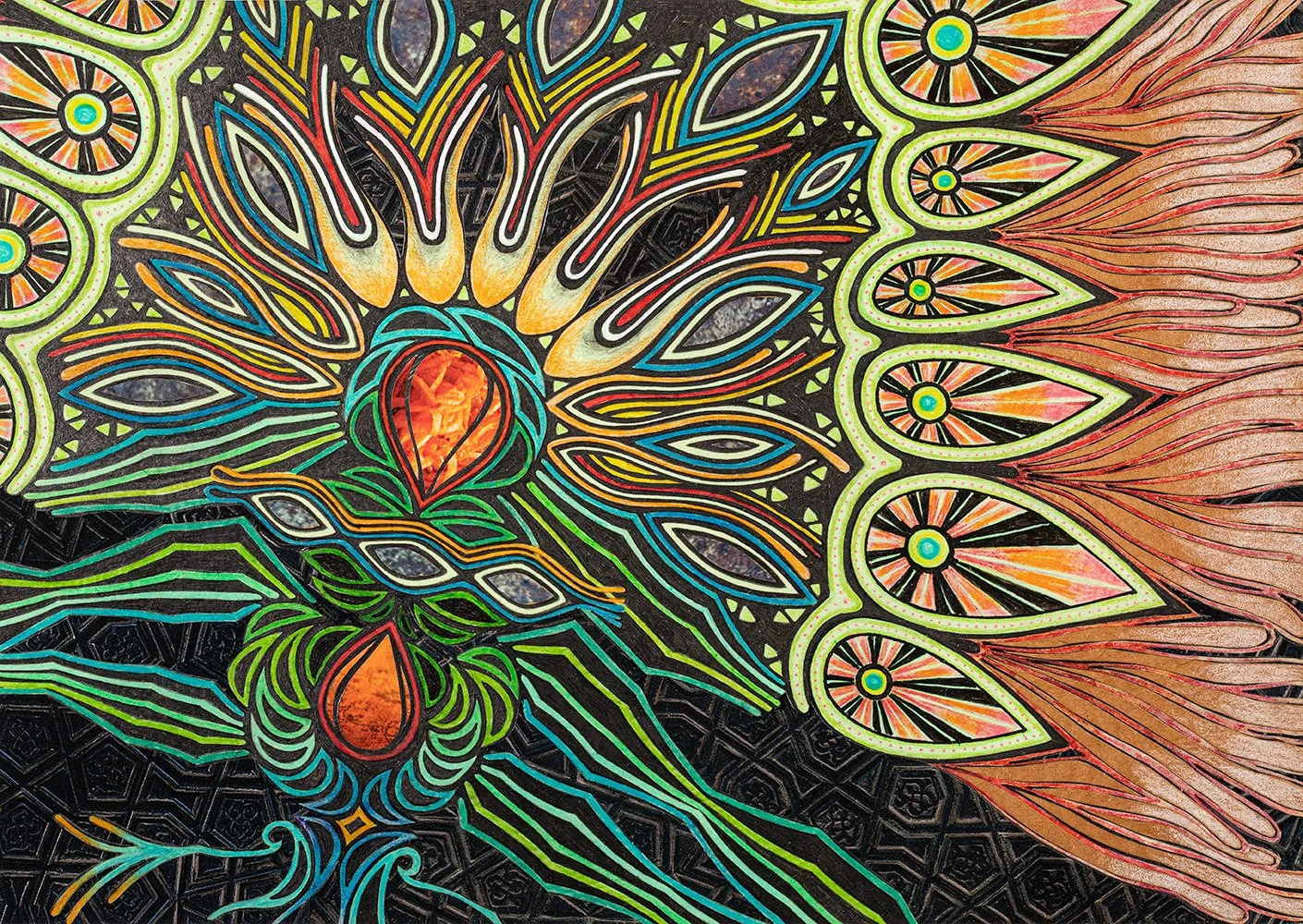
‘Colored Spider in a Web’ – mixed media 24 x 34 cm | 2021
When it comes to my child, it gets plenty of confirmation from those around us, mind you. Other people tend to say it before we do, and then my son confirms it with a loud yes, which he proceeds to repeat ten times over. (Repetition — another ADHD thing: check!) Poor obedience (‘no’ is also a word) is another symptom. (Duly ticked.) With his selective hearing and his impulsive behaviour (check), you’re in trouble soon enough, and what advice do we get (from people who trained for this): ‘pop him into a scouting club, they have lots of structure there and the boy will be toeing the line in no time.’ (‘Ha, not this boy,’ I nearly added, almost proudly.) And what happened? After the big summer camp, the leaders informed us… that perhaps we ought to have the child tested, because he was NOT possible to regulate. Lovely to the other children, mind (pffff, that’s a fine bit of nuance), but over every boundary, literally the WHOLE time. ‘Well now,’ we said, exchanging a theatrical look of utter disbelief, ‘you don’t say. My child never does that otherwise.’
No, but seriously now. In all earnestness, we were terribly worried about the camp leaders the day we dropped our son off. About our boy, likewise. No need on his account, as it turned out. He came home in exactly the same clothes and underclothes he’d left in, a suntanned little face, hair standing on end, a grin from ear to ear, and he’d had the most tremendous time (a feather in the cap of the people who organised this club, because what a party they made of it — unbelievable!). He could have stayed there for WEEKS more, that’s how much fun he’d had. Not one of the volunteer leaders had signed up for that, believe me. We wisely keep even the suggestion of it to ourselves, so as to prevent an imminent nervous breakdown in these lovely people. They’re at home now with their own children, feeling grateful for everything, including the repeated failure to flush, the squabbles between them, the not tidying up after their little behinds, and the resistance at bedtime. (Putting things in perspective is a virtue.)
Oh dear, I hear you thinking. How unpleasant, to talk about your child this way. (He understands sarcasm and irony as well as anyone, by the way, but still…) Ahem. When I read this out to him, which I happily do, a ‘big smile’ appears on his face and I can watch the counter on his dopamine system climb on the spot. Being naughty, getting up to mischief, pranks, call the beast what you will — it sits absolutely RIGHT AT THE TOP of his list of favourite things to do. Not that he means anyone any harm by it, but he gets an enormous kick out of strong reactions, startled responses, intense emotions (check, check, check), because ‘ting, ting, ting, ting, ting, ting…’, there goes his dopamine counter again. He HAS to do kick-ass things, the kind that surprise others or perhaps meet with their disapproval, to get a ‘hit’ of the stuff. That stuff others are better and above all more evenly supplied with. Others don’t have to try nearly so hard for it. And that brings me to what this whole exposition is actually about. How do we make sure that this lovely little man (original, super sociable, gentle, fair-minded, affectionate, loyal, cuddly, creative, funny, animal lover, caring towards his grandmother, and many more fine qualities besides) and every other thrill-seeker among us doesn’t have to try quite so desperately hard to feel just as okay as everyone else? In this respect he is (they are, we are) forever two goals down. And that feels unfair.
Here’s the thing. The problem lies mainly in the executive functions, which at school these days are treated (yes!) as ‘superpowers’, each with its own animation and terminology. Stopping power, for instance, is entirely absent in my little friend. Stop is a word he doesn’t recognise, doesn’t use, doesn’t want explained, that simply isn’t in his kit (not yet!). The same goes for starting power (something I wasn’t exactly good at myself back in the day). While he can read like a demon and never shies away from an argument, complete with complicated words, drawing connections, reaching conclusions and putting emotions into words, the things that look simple he simply cannot do yet. In that, he lags behind.
What children like him need is structure. External structure can, in time, be internalised, and if it’s applied consistently and clear priorities are set, then in the long run these basic skills are learned and the child can hold their own a little more comfortably in organised settings. Now the joke, of course, is that parents are the obvious people to bring this structure into a household with a child like that — and suddenly it turns out the apple never falls far from the tree, because usually one of the parents, or both of them, isn’t much good at it either. What is a nice by-catch, though, is that the child gets to experience first-hand that it can be done differently, and that parents with the same sort of shortcomings turn out to manage in life, can be happy, take other paths, and don’t have to slink through it ‘entirely’ as oddballs. At least, that’s what I’m hoping. The wish is father to the thought, isn’t it?
And perhaps we ought to take a look at how different we’re allowed and able to be (because plenty of people carry this stamp, if the papers are anything to go by). The label works splendidly in conversation with outside parties, to explain, to gain understanding and help where needed, but it mustn’t become an identity. It isn’t who my child is. What if we simply called it ‘different’? And why must we have a separate word for every distinctive category anyway? We have ‘different’ in this world in every conceivable shade — they also call it diversity. Wonderful, isn’t it? ‘We exclude no one’ is the credo these days.
Those of us who are the somewhat energetic ‘differently sorted’ have not only pitfalls but also qualities that could be put to use in all kinds of ways, provided the group and its accompanying social rules allow for it. Those qualities include superfocus, great enthusiasm, wide-ranging interests, humour, spontaneity, a talent for improvisation, curiosity, the nerve to ask, resilience, creativity and associative thinking. We live in a world with so many different systems that are supposed to serve us. Us — that’s all of us, isn’t it? And yes, that asks something of us too, the differently sorted, in all our variations. Because the world naturally can’t be expected to make a special exception for every differently sorted creature who speaks up. We could be a great deal more okay, in general, with the fact that we’re all unique and a little bit different. Don’t you think?
And on a closing note, a few philosophical gems, because they apply and because I happen to have a special place in my heart for the old thinkers.
Aristotle, with his telos and the oak. Every being has a nature of its own that wants to come into bloom; raising a child is not shaping them to a mould, but creating the right conditions. You don’t ask an acorn to become a rose bush.
Nietzsche’s ‘become who you are’ — and yes, once again I find what he has to say fits my own train of thought so well (partly because it suits me better, of course). He harboured a pure distrust of the morality that tames what is lively and wild into something well-behaved and useful.
Foucault on the disciplinary institutions (school, barracks, factory) that bring bodies into line at fixed times in fixed rows. That’s what I meant earlier. Could we stretch the boundaries a little, so that the extremes fit inside them too? All of this connects to my piece Doctrine of Time, in which I describe clock time as a straitjacket. My dear son is in all likelihood (in fact with absolute certainty) the most kairos-oriented person in the house — which means he trusts his internal and deeply personal clock, but doesn’t necessarily have an eye for the time we share together.